The editor assembles the shot footage to create a film. He or she selects the best takes, determines the order and duration of each shot, establishes the rhythm, and, at times, alters the narrative structure. The editor works with the director from the first cut through to the final cut.
In a nutshell
- He selects the shots, edits them together, and sets the film's pace.
- In the film industry, the position is called chief editor, who is assisted by one or two assistant editors.
- On a feature film, the minimum wage for a chief editor is €1,833.05 gross per week, based on a 39-hour workweek.
- The César Award for Best Editing has honored this craft since the first ceremony in 1976.
- ICD Code: L1507, audiovisual editing and post-production.
What does an editor do?
During filming, he receives the footage from each day—the rushes—and often begins an initial cut. He lets the director know if a shot is missing or a scene isn’t working, as long as there’s still time to reshoot.
After filming, he works with the director to put the film together scene by scene. The first cut is often much longer than the final film: scenes need to be tightened up, cut, and sometimes moved or removed entirely. Screenings for the producer—and sometimes for a test audience—guide the final versions.
Once the edit has been approved, he prepares the work for the other post-production teams: sound editing, mixing, visual effects, and color grading.
Video editor or audio editor: What's the difference?
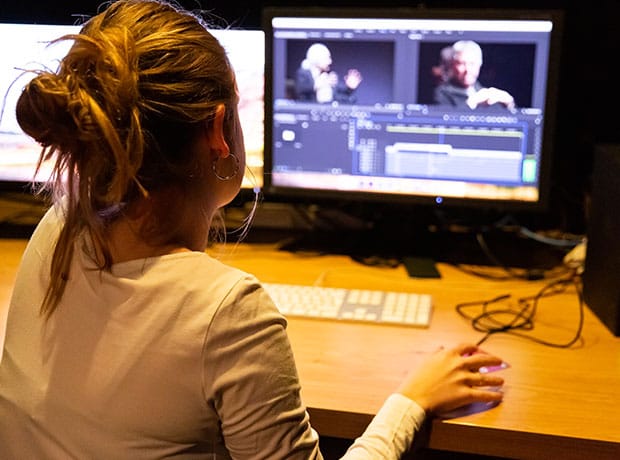
The video editor assembles the film from the shots. The sound editor then takes over: he cleans up the dialogue, adds ambient sounds and sound effects, and prepares the tracks for the mixer.
In film, the chief editor relies on assistants, who organize the raw footage, synchronize the video and audio, and prepare the exports. In television and news reporting, the editor often works alone, under much tighter deadlines.
Who does the editor work with?
His first partner is the director, with whom he spends weeks in the editing room. He reports to the producer, who offers feedback on the cuts, and follows the post-production manager’s schedule.
He also communicates with the script supervisor, whose reports describe each take, and forwards his work to the sound editor, the visual effects supervisor, and the colorist.
What skills do you need to become a film editor?
You need a sense of rhythm and storytelling: knowing when to cut, what a shot conveys, and what a scene can do without losing anything. You also need to be proficient in editing software, such as Avid Media Composer, Adobe Premiere Pro, or DaVinci Resolve.
Finally, the job requires patience and tact. The editor spends weeks working with the same director, must defend his or her ideas and be willing to set some aside, and must maintain a fresh perspective on footage he or she has seen hundreds of times.
How much does a film editor earn?
On a feature film, the minimum salary for the chief editor is €1,833.05 gross per week, based on a 39-hour workweek. The minimum salary for the first assistant editor is €1,121.74.
| Post Office, Movie Theater | Minimum gross weekly pay, based on a 39-hour workweek | Low-Budget Film (Appendix III) |
|---|---|---|
| Lead Editor | 1 833,05 € | €1,213.73, plus €1,238.65 in revenue-sharing |
| First Assistant Editor | 1 121,74 € | €950.54, plus €342.39 |
| Second Assistant Editor | 559,32 € | €559.32, excluding profit-sharing |
These amounts are taken from the wage scale in the collective bargaining agreement for film production (IDCC 3097), effective as of May 1, 2026. For low-budget films listed in Appendix III, the base wage is lower but is supplemented by a share of the film’s box office receipts. Television is governed by other collective bargaining agreements.
According to France Travail, hiring is primarily done through standard fixed-term contracts, and sometimes through permanent contracts, at television networks, production companies, and post-production companies.
What kind of education do you need to become a film editor?
France Travail states that entry into the field requires a BTS in audiovisual studies, supplemented by editing experience, and that proficiency in one or more editing software programs is required. In the film industry, people generally start out as assistant editors.
At ESRA, the ESRA Cinema program is a three-year course of study leading to a state-accredited “ degree ” (Bachelor’s degree) at the Bac+3 level, with more than 700 hours of instruction per year and at least two productions per year, which are screened before a jury. In the third year, the editing specialization focuses on film editing, color grading, and visual effects.
What career opportunities and prospects are there?
Editors work in film, TV series, documentaries, television, advertising, and web content. Many switch between formats depending on the project.
Among ESRA alumni, Sophie Reine (ESRA 1992) won the César Award for Best Film Editing in 2009 for *Le Premier Jour du reste de ta vie*, before going on to direct her own films, and Florent Vassault (ESRA 1999) was nominated for the César Award for Best Film Editing in 2020 for *La Belle Époque*, starring Anny Danché.
Sources: Légifrance, IDCC 3097 collective bargaining agreement, pay scale as of May 1, 2026; France Travail, ROME code L1507; Académie des César. Verified on September 29, 2026.
Frequently Asked Questions
What does an editor do?
He edits the shot footage into a film: he selects the takes, determines the order and duration of the shots, establishes the pacing, and, at times, changes the narrative structure in collaboration with the director.
How much does a film editor earn?
The minimum wage for a chief editor is €1,833.05 gross per week, based on a 39-hour workweek, and that for a first assistant editor is €1,121.74, according to the pay scale set forth in the collective bargaining agreement for film production in effect as of May 1, 2026.
What software does an editor use?
The most widely used are Avid Media Composer, Adobe Premiere Pro, and DaVinci Resolve.
What's the difference between a video editor and an audio editor?
The video editor assembles the film from the shots. The sound editor then works on the dialogue, ambient sounds, and sound effects, and prepares the mix.
What kind of education do you need to become a film editor?
According to France Travail, you can enter this field with a BTS in audiovisual studies, supplemented by editing experience. In the film industry, people generally start out as assistant editors.
Is there a César Award for editing?
Yes. The César Award for Best Editing has been presented since the first ceremony in 1976. Sophie Reine, an ESRA alumna, won it in 2009 for *Le Premier Jour du reste de ta vie*.
The other cinema jobs

Director of Photography


Production and Distribution

Film Directing,
Series and TV
Programs offered at ESRA Paris
The school offers post-baccalaureate Programs in all three audiovisual fields. These Programs award a state-approved degree recognized by the French Ministry of Higher Education and Research.
Producer, Director, Editor
Audiovisual, Sound Systems, Music,
Radio, Video Games
Animation, 3D Compositing & VFX, Management & Production, Modeling
Master's-level Programs also on offer
Develop your technical and creative skills in the film industry with the Master DHEC, a state-approved degree .
To become a film producer, distributor, programmer, seller or buyer
Audiovisual, Live, Music,
Radio, Sound Design
DHEC Filmmaking
in English
To manage the entire production of a project: script writing, locations, casting...