The visual effects supervisor, or VFX supervisor, designs and oversees all the special effects shots in a film or TV series: digital sets, crowds, creatures, explosions, and background removals. They get involved as early as the pre-production phase, monitor the filming of these shots, and then lead the visual effects teams through to delivery.
In a nutshell
- He serves as the link between the production team and the studios that create the visual effects.
- He is on set during the staged shots to ensure that the footage shot can be used.
- Since 2022, a César Award has been presented for best visual effects and has recognized the work of visual effects supervisors.
- In France, the international tax credit increases from 30% to 40% when visual effects expenses exceed 2 million euros.
- Not to be confused with the physical effects supervisor, who creates the effects live on set.
What does a special effects supervisor do?
During pre-production, he reviews the script with the director to identify all the shots that will require visual effects, suggests a technique for each one, and estimates the cost. He often prepares a pre-visualization—an animated mock-up of complex sequences—to finalize the staging before filming begins.
On set, he ensures that every composited shot is filmed under the right conditions: green or blue screens, motion tracking markers, measurements of the lighting and set dimensions, and shots without actors. A mistake at this stage can cost days of work in post-production.
After filming, he assigns the shots to the various teams or studios, monitors their progress during regular reviews, and approves each shot with the director until it is delivered to the editing and color grading departments.
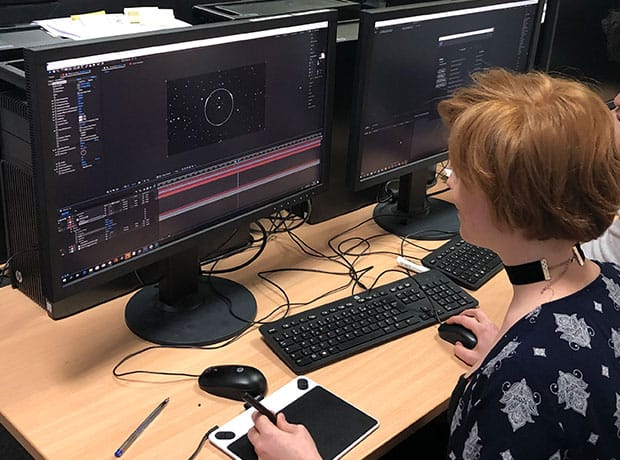
Special effects or visual effects: What's the difference?
Physical special effects are created live on set: rain, smoke, controlled explosions, and mechanical stunts. Visual effects are created digitally after filming, using footage shot on set or generated entirely through computer graphics. The English term “VFX,” short for “visual effects,” refers to the latter.
The film production pay scale does, in fact, include a category for the physical effects supervisor—a on-set position—but it does not include a category for the visual effects supervisor, whose work is primarily carried out in post-production at specialized studios.
Who does the VFX supervisor work with?
He works with the director, who decides what he wants to see; with the cinematographer, to ensure that the lighting in the composited shots matches; and with the production manager, who sets the budget.
In post-production, he directs the artists who create the visuals: compositing artists, 3D modelers, 3D animators, texture artists, digital lighting artists, and matte painters. He also works closely with the editor and colorist.
What skills do you need to become a special effects supervisor?
A solid understanding of the entire visual effects production pipeline is required: filming, motion tracking, modeling, animation, rendering, and compositing. The supervisor doesn’t need to do everything himself, but he must be able to evaluate each step and anticipate problems.
It also takes a photographer’s eye to ensure that a manipulated image has the same lighting and grain as the rest of the film, as well as strong organizational skills: keeping track of hundreds of shots, deadlines, and a budget. Finally, the job requires the ability to translate a director’s requests into technical instructions for the crews.
How much does a special effects supervisor earn?
The collective bargaining agreement for film production does not set a minimum wage for visual effects supervisors: its pay scale only includes physical effects supervisors, at €1,930.06 gross per week based on a 39-hour workweek. The VFX supervisor is most often employed by a visual effects studio or hired by the production company for the duration of the film, and their compensation is negotiated.
| Landmark | Amount | Source |
|---|---|---|
| On-Set Supervisor of Physical Effects for Film | €1,930.06 gross per week, based on a 39-hour workweek | Collective Bargaining Agreement for Film Production, Pay Scale as of May 1, 2026 |
| Same position, low-budget film (Appendix III) | €1,249.62 per week, plus €1,360.87 in profit-sharing | Same grid |
| Job Openings in Graphic Design and Multimedia | 80% between €1,802 and €2,667 gross per month | France Travail, ROME code E1205, first quarter of 2026 |
France Travail's job classifications cover all graphic design and multimedia professions (ROME code E1205, which includes special effects graphic designers), and not just supervisors, who have a much higher level of experience.
The sector receives government support: the international tax credit, which attracts foreign film productions to France, amounts to 30% of eligible expenses incurred in France, and 40% for a fiction film whose expenses for digital visual effects produced in France exceed 2 million euros, up to a limit of 30 million euros per production, according to the CNC.
What kind of education do you need to become a special effects supervisor?
You don’t become a supervisor right out of school: you work your way up to the position after several years as a graphic designer, then as a team leader in a specific specialty—such as compositing, 3D, or tracking. The initial training is designed to help you acquire these technical and artistic fundamentals.
At ESRA, the ESRA Animation program is a three-year course leading to a state-accredited “ degree ” degree at the Bac+3 level, with more than 700 hours of instruction per year in 2D and 3D animation: art direction, character design (including rigging, textures, and lighting), storyboarding and layout, and the production of an animated film. In September 2026, the Network of French Animation Film Schools (RECA) awarded its accreditation toESRA Rennes, followed byESRA Paris. On the filmmaking side, the ESRA Cinema program offers a third-year specialization in editing that covers film editing, color grading, and visual effects.
What career opportunities and prospects are there?
VFX supervisors work for visual effects studios, post-production companies, and film, television, and advertising productions. Some specialize in on-set work, while others focus on supervision within a studio.
Among ESRA alumni, Mikaël Tanguy (ESRA 2004) was nominated for a César Award for Best Visual Effects in 2023 for *Novembre*, directed by Cédric Jimenez. This career path leads to roles such as heading a visual effects department, founding a studio, or directing.
Sources: Légifrance, IDCC 3097 collective bargaining agreement, pay scale as of May 1, 2026; CNC, international tax credit; France Travail, ROME code E1205; Académie des César. Verified on September 24, 2026.
Frequently Asked Questions
What is the difference between special effects and visual effects?
Physical special effects are created live on set: rain, smoke, and controlled explosions. Visual effects, or VFX, are created digitally after filming, using footage shot on set or computer-generated imagery.
How much does a VFX supervisor earn?
The collective bargaining agreement for film production does not set a minimum wage for this position: compensation is negotiated with the studio or production company. For comparison, the physical effects supervisor has a minimum gross weekly wage of €1,930.06, based on a 39-hour workweek, according to the pay scale as of May 1, 2026.
Is the VFX supervisor on set?
Yes, for composited shots. He makes sure the green or blue screens, motion tracking markers, and lighting setups are in place so that the footage can be used in post-production.
What is the career path to becoming a VFX supervisor?
This position is typically attained after several years as a graphic designer, followed by experience as a team leader in a specialized field such as compositing, 3D, or tracking. Training in animation or post-production provides the foundation.
Is there a César Award for visual effects?
Yes, since 2022. The César Academy presents this award to recognize the work of a film’s visual effects supervisors. Mikaël Tanguy, an ESRA alumnus, was nominated in 2023 for *Novembre*.
Does the tax credit help the visual effects industry in France?
Yes. According to the CNC, the international tax credit increases from 30% to 40% of eligible expenses for a fiction film in which expenses for digital visual effects produced in France exceed 2 million euros.
The other cinema jobs

Animation


Programs offered at ESRA Paris
The school offers post-baccalaureate Programs in all three audiovisual fields. These Programs award a state-approved degree recognized by the French Ministry of Higher Education and Research.
Producer, Director, Editor
Audiovisual, Sound Systems, Music,
Radio, Video Games
Animation, 3D Compositing & VFX, Management & Production, Modeling
Master's-level Programs also on offer
Develop your technical and creative skills in the film industry with the Master DHEC, a state-approved degree .
To become a film producer, distributor, programmer, seller or buyer
Audiovisual, Live, Music,
Radio, Sound Design
DHEC Filmmaking
in English
To manage the entire production of a project: script writing, locations, casting...