

Ranked No. 1 among private schools in the
, according to the 2026 Le Figaro Étudiant rankings

+15.000 alumni
in the industry

degree
state-approved

+55 International awards
, César, Oscar, Grammy
Ranked No. 1 among private schools in the
, according to the 2026 Le Figaro Étudiant rankings
+15 000 alumni
in the industry
degree
state-approved
+55 International awards
, César, Oscar, Grammy
ESRA Sound at a Glance
- degree : DESTS (degree e for Advanced Studies in Sound Technology), accredited by the government at the bac+3 level and registered with the RNCP, entry 41243, level 6.
- Duration: three years after high school graduation, with more than 750 hours of instruction per year.
- Admission: Parcoursup and the school’s entrance exam; open to students with any high school diploma.
- Specialization: Five options in the third year: Audio-Visual Sound, Music Production, Live Sound, Radio, and Video Game Sound.
- Campuses: Paris, the French Riviera (Nice and Cannes), Brittany (Rennes), and Brussels.
- Tuition for 2027–2028: between €9,000 and €9,650 per year, depending on the campus in France.
- After high school ( degree ): Optional fourth year in New York.
The Program, Year by Year
The first two years cover all areas of sound. The third year is devoted to a specialization and the thesis. Details of the courses are included in the 2026–2027 course catalogs.
1st Year: The Basics of Sound
Acoustics, electronics, and the physics of sound; sound recording techniques; sound analysis; radio and audiovisual production. In the studio: Pro Tools, Ableton Live, processing, and effects. Support in mathematics and physics, as well as music theory classes, are offered as electives. Projects for the year: an audiobook, beatmaking, the stereo recording of a musical ensemble, and a film.
2nd year: mixing, post-production, and distribution
Sound recording and mixing, audiovisual post-production, sound reinforcement, sound design, venue acoustics, and audio networks. Seminars on Dolby Atmos, the R128 mixing standard, radio, and video games. Workshops on “mix-in-the-box,” Logic Pro, scoring for film, and sound integration in video games; optional Pro Tools 101 and 110 certifications. Productions: a news report, a radio program, the recording of an acoustic instrument, and a film.
3rd year: a major and a thesis
Each track has its own courses, projects, and opportunities to meet with professionals. The thesis is supervised by a thesis advisor.
Five specializations in the 3rd year
In the third year, each student chooses one of the five options listed below, as outlined in the ESRA Son 2027–2028 brochure.
The five options:
Join us!
His Audiovisual Image
On-set sound recording, sound post-production, dubbing, surround and immersive mixing, using an Avid S6 console and Pro Tools MTRX.
Music Studio
Studio techniques, multichannel mixing, sound synthesis, arrangement, and music industry law. Mixing contests and sound design projects presented to a panel of judges.
Live Sound System
Sound reinforcement systems, backline, Dante digital audio networking, event recording. The semester concludes with the sound reinforcement for an acoustic concert.
Radio
Radio production and branding, binaural sound, multi-camera recording. Live broadcasts on ESRADIO, particularly during open house events.
Video Game Sound
Sound design for video games and animation, integration with Wwise, Unity, and Reaper, binaural sound, and interactive systems.
Sound productions throughout the year
Every year, students work on a series of projects: audiobooks, band recordings, news reports, radio programs, and film soundtracks. Each stage is supervised by professional instructors, and several of the projects are evaluated by a jury.
In the third year, projects of increasing difficulty culminate in the production of work under professional conditions.

ESRA, a member of the Erasmus+ program
ESRA participates in the Erasmus+ program, offering its students the opportunity to enrich their educational experience through mobility and international exchange programs.

At the end of the training
You will be able to:
Design, record and mix projects for professional artists
Create soundscapes and soundtracks for film, television and video games
Sound engineering for concerts, festivals, shows and live events
Work in the music, film, radio and live performance sectors
Why choose
ESRA Son?
Le Figaro Étudiant ranked ESRA as the top private school in 2026 for the second consecutive year in an independent ranking, reflecting our graduates’ strong employment rate, their recognition within the industry, and the quality of our facilities and faculty.

Exceptional insertion rate
85% of graduates employed one year after graduation

Professional Studios
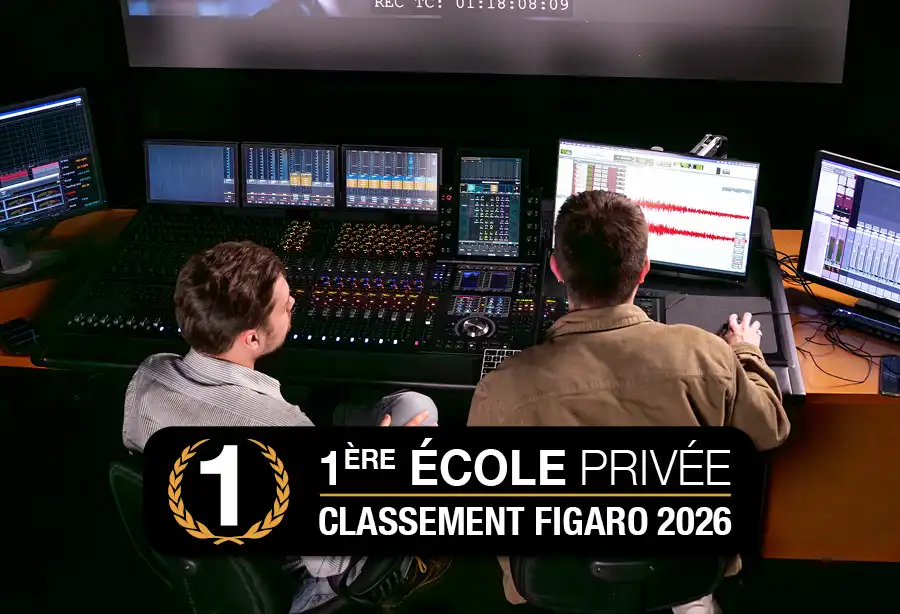
Avid S6 console and Pro Tools MTR

A campus combining
all audiovisual professions Film, Sound and Animation

business events
for students all year round!
How much does ESRA Son cost?
In 2027–2028, tuition ranges from €9,000 to €9,650 per year, depending on the campus in France. The tuition rates for each campus are listed in the ESRA Son 2027–2028 brochure.
These include course materials, technical costs for productions included in the program, and insurance for equipment during filming.
Since the DESTS program is recognized by the government, students can apply for a CROUS scholarship based on financial need and for housing assistance. ESRA also awards its own scholarships and offers payment plans through the school or its partner banks.
Request ESRA Son brochure
Discover the school in detail: the program, the campuses, the facilities and the careers of those who have chosen it.
Continuing Education
Since 2008, ESRA has been offering its students and international students the opportunity to pursue an optional 4ᵉ year in New York, in partnership with Stonestreet Studios, right in the heart of Manhattan.

What Happens After ESRA?
Our alumni collaborate with companies such as Gaumont, Pathé, Canal+, Netflix, TF1, FTV, RMC, BFM, WEBEDIA, TRANSPAMEDIA, as well as independent studios and productions.

Follow in the footsteps of 30% of our students: become a scholarship recipient
Studying at ESRA means accessing an outstanding education in the fields of filmmaking, sound, and 3D animation. And it's also possible without financial obstacles.
ESRA offers scholarships and payment plans in partnership with the school and affiliated banks.
Contact us to learn more about financial aid.
choose your campus for esra Son training
The ESRA Sound program is offered in Paris, on the French Riviera (Nice and Cannes), in Rennes, and in Brussels. The DESTS, which is accredited by the government, is awarded in Paris, on the French Riviera, and in Rennes.
Alumni testimonials

The school allowed me to familiarize myself with professional equipment that is difficult to access outside of a specialized environment. I benefited from both theoretical and practical instruction, supervised by professors and speakers from the industry, in conditions close to the professional world. This training also offered me the opportunity to explore different audiovisual professions, which helped me refine my career choices.
 Nathan Hourbeigt
ESRA 2024 – TV Directing
★★★★★
Three years rich in human and professional experience. I had the chance to work with wonderful people and to be well supported. We experienced a real group adventure, with intense projects. Thank you to ESRA and to all those who crossed my path.
 Emilien Le Labourier
ESRA 2024 – Image
★★★★★
Thank you to this incredible graduating class, to Jennifer, to Mr. Bonnot, and to the teachers for their support. We grew together throughout this adventure. I am proud of what we have accomplished. I hope we will meet again in the future, united by our shared passion.
 Léa Hue
ESRA 2024 – Film Directing
★★★★★
These years at ISTS have been an exciting immersion. We collaborated, learned, and shared powerful moments. Thank you to everyone I worked with. I found more than just classmates; I found true friends. I am proud of this collective journey.
 Mathias Baillou
ESRA Brittany
★★★★★
Thanks to you, I have grown. I understood who I am. Understood what I wanted to be. All of this allowed me to write my film, "Cette Nuit à Offeu," which would be nothing today without the prodigious advice of some, and the immense will that you all demonstrated during its selection.
 François Gaudière
DHEC Screenwriting and Directing🇫🇷
★★★★★
One of my fondest memories of ESRA is the equipment available and the fact that I was able to do live TV, which gave me the impression of working for an international channel. It was an experience that taught me how to manage my career as a live TV producer, and how to manage a team of 80 people.
 Maxence Carion
ESRA TV – Director
★★★★★
ESRA is, above all, about encounters, people who lent me a hand and helped me carry LED panels! It's quite curious to think that chance encounters shape a destiny, especially when you have a taste for cinema and doing things well. I found my path thanks to ESRA.
 Romain Guimmara
ESRA 2021 – Image Option
★★★★★
With great emotion, I remember myself in the first year at ESRA, working on my first projects and meeting such talented people. The student union also contributed so much to us. Thank you to the entire teaching team who always supported my professional project and to all the people who pushed me to be better.
 Laurie Cauffet
ESRA 2021 – TV Directing
★★★★★
Student films

JERKY FLOW

WINTER ALLEGRO

Resilience

The Last Curse

Phillie's Dinner

And After

FRD
jobs and career opportunities
85% of ESRA SON graduates are employed in the audiovisual industry one year after graduation. Here are just a few examples of the jobs available:


Live


Do you have any questions?
Is the ESRA degree recognized by the State?
Yes. The degrees from ESRA Cinema (DESRA), ESRA Sound (DESTS), and ESRA Animation (DESFA) are accredited by the Ministry of Higher Education, Research, and Space at the bac+3 level and registered with the RNCP at level 6, the bachelor’s degree level within the National Qualifications Framework, for the Paris, Côte d’Azur, and Rennes campuses. The DHEC is accredited at the bac+5 level, RNCP Level 7, in Paris. This accreditation was renewed by decree on February 17, 2025, for four years beginning with the 2025 academic year.
How do I join ESRA?
ESRA Son offers a state-accredited degree : Admission to the first year requires application through Parcoursup, in addition to the school’s entrance exam. Create your ESRA applicant account, then submit your ESRA application on Parcoursup between January 18 and March 11, 2027, and confirm it by April 1, 2027. On the ESRA admissions platform, complete your application and select your exam date. The admissions exam takes place in April or May 2027 and consists of a presentation of your motivation, a multiple-choice test on general knowledge, and an interview with an analysis component. It is open to all high school graduates, regardless of academic record. Results will be posted on Parcoursup starting June 1, 2027.
How much does ESRA Son cost?
In 2027–2028, ESRA Son costs between €9,000 and €9,650 per year, depending on the campus in France; details are provided in the ESRA Son 2027–2028 brochure. Since the “ degree ” program is state-approved, students can apply for a CROUS scholarship and housing assistance. The school also offers its own scholarships and payment plans.
What courses does ESRA Son offer?
Five options in the third year, according to the ESRA 2027–2028 brochure: Audiovisual Sound Design, Music Studio, Live Sound, Radio, and Video Game Sound.
Do you need an engineering degree e to become a sound engineer?
No. “Sound engineer” is a job title, not a degree in engineering: it is a profession entered through specialized training. ESRA Son offers a three-year program that prepares students for this career and awards the DESTS ( degree ), a state-recognized diploma equivalent to a three-year post-secondary degree. It is not an engineering “ degree ” as defined by the Commission des titres d’ingénieur (CTI).
What equipment is available at ESRA?
Each ESRA campus has post-production and multi-station rooms equipped with powerful computers and the latest software, whether for film, sound or animation. In addition, each campus has an equipment room containing a range of cameras, from HD Nikon and Canon to Sony FS7 and F55, and each school has an ARRI ALEXA 35 camera and numerous camera accessories, monitors and so on. They also have a wide range of microphones, recorders, plug-ins and laptops available to students all year round. This is one of the school's strong points.
Who are ESRA's alumni?
Over 15,000 audiovisual professionals have graduated from ESRA since its creation in 1972. Check out our alumni page to discover some of our most memorable achievements, including 47 César nominations, an Oscar win, two Grammy Awards, selections at the Cannes Film Festival and the Venice Film Festival, song production for Daft Punk, Beyonce, A$AP Rocky, Kendrick Lamar, Big Flo et Oli and Orelsan, VFX and animation on some of the world's biggest films, and many other professional and public accolades.