
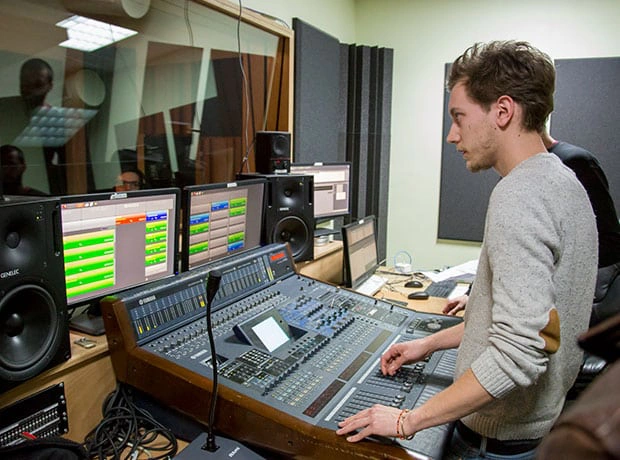
The radio broadcast engineer operates the technical system that connects the studio to listeners. In the studio, he or she adjusts and mixes the audio for live broadcasts; in the master control room, he or she monitors the broadcast to FM and DAB+ transmitters, satellite, and the internet, and takes action at the first sign of a problem.
In a nutshell
- It ensures sound quality and uninterrupted live broadcasts 24 hours a day.
- In radio, this position goes by several names: production technician, operations technician, or broadcast technician.
- At a private national radio station, the minimum gross monthly salary for an operations technician is €2,132.69.
- According to Arcom, by the end of 2025, DAB+ covered 66% of the population for reception inside buildings.
- This profession is practiced at national, local, and community radio stations, as well as at broadcasters.
What does a radio broadcast engineer do?
In the studio, he sets up the set before the show: microphones, remote guests, connections with reporters, jingles, and music. During the live broadcast, he mixes voices and sounds, plays pre-recorded segments, and handles unexpected issues, such as a guest whose line drops or a microphone that crackles. At many radio stations, this role is called a technician-producer.
From the central control room, he monitors the signal being sent to FM transmitters, DAB+ multiplexes, the satellite, and streaming platforms. He monitors audio levels and quality, switches to backup links in the event of a failure, and coordinates responses with broadcast operators.
It also sets up mobile production units for public broadcasts and live outdoor broadcasts.
Production Technician or Broadcast Technician: What's the Difference?
The production technician works in the studio, right alongside the show: he handles the live on-air audio, working with the host and the director. The operations or broadcast technician oversees the entire technical chain, from the studio to the transmitters, and is responsible for ensuring uninterrupted signal transmission.
Digital radio is transforming the industry. According toArcom, by the end of 2025, DAB+ served nearly 18,000 municipalities, with an average of about 40 radio stations in each, and the goal for 2026 is to cover 80% of the population on the go with metropolitan multiplexes.
Who does a radio broadcast engineer work with?
He works with program hosts, journalists, and producers, as well as with the music programming team. He reports to the radio station's technical department, which is headed by a department head or technical director.
Externally, he communicates with broadcast operators—who manage the transmitters—and with teams from other radio stations and platforms when a program is shared or rebroadcast.
What skills do you need to become a radio broadcast engineer?
You need a good ear and proficiency with mixing consoles, microphones, and radio broadcasting software. You also need to understand computer networks, audio codecs, and transmission links, because radio audio is transmitted as data between the studio, transmitters, and the internet.
Finally, this job requires quick reflexes: when you’re on the air, a mistake is immediately noticeable. You have to be willing to work irregular hours, including early mornings and weekends, because radio never stops.
How much does a radio broadcast engineer earn?
At private radio stations, the minimum wage is based on the employment index. At a national radio station—classified as “Type 3” because it serves a population of more than 30 million—the minimum gross monthly wage for a production technician is €2,061.36, and for an operations technician, €2,132.69.
| Employment, private national radio station (Type 3) | Index | Minimum Gross Monthly Wage |
|---|---|---|
| Entry-Level Production Technician | 121 | €1,826.99, adjusted to the minimum wage: €1,867.02 |
| Technical Director | 144 | 2 061,36 € |
| Operations Technician | 151 | 2 132,69 € |
| Senior Maintenance Technician | 165 | 2 275,35 € |
| Operations Technician Coordinator | 170 | 2 326,30 € |
| Head of the Technical Department | 189 | 2 519,91 € |
These amounts are based onthe agreement of June 27, 2025, regarding the minimum wages set forth in the collective bargaining agreement for the broadcasting industry (IDCC 1922), which was extended by an executive order dated September 4, 2025. Wages are calculated based on the employment index: €15.14 per point up to index 120, then €10.19 per point above that. The indices are those in the table appended tothe agreement of July 2, 2024. The minimum wage for entry-level employees is lower than the national minimum wage (SMIC), which has been €1,867.02 gross per month since June 1, 2026; therefore, the SMIC applies.
At Type 2 radio stations, the indices are lower for the same positions: 134 for a production technician, or €1,959.46, and 141 for an operations technician, or €2,030.79.
What kind of education do you need to become a radio broadcast engineer?
This career is accessible after completing training in sound or audiovisual production. Specializing in radio helps you learn about the tools specific to on-air work and land your first substitute assignments.
At ESRA, the ESRA Sound program is a three-year course of study leading to a state-accredited “ degree ” degree at the Bac+3 level, with more than 700 hours of instruction per year. The first two years cover all aspects of sound production; in the third year, the radio specialization focuses on the design and production of audio programs for radio and digital media. In 2020, radio students launched a mixing contest under the school’s label.
What career opportunities and prospects are there?
Radio broadcast engineers work for national, regional, local, and community radio stations, as well as for broadcast operators and podcast producers. Their skills are also valuable in the event and television industries.
A career path leads to a position coordinating operations, and then to managing a technical department or the technical division of a radio station.
Sources: Légifrance, collective bargaining agreement for the broadcasting industry (IDCC 1922), agreements dated July 2, 2024, and June 27, 2025; Arcom, statement dated December 18, 2025; minimum wage as of June 1, 2026. Verified on September 29, 2026.
Frequently Asked Questions
What does a radio broadcast engineer do?
He operates the technical systems for a radio station: he adjusts and mixes the audio for live broadcasts, monitors the transmission to FM and DAB+ transmitters, the satellite, and the internet, and takes action in the event of an incident.
How much does a radio technician earn?
At a private national radio station, the minimum gross monthly salary is €2,061.36 for a production technician and €2,132.69 for an operations technician, according to the collective bargaining agreement for the broadcasting industry and the agreement dated June 27, 2025.
What is the difference between a production technician and a broadcast technician?
The production technician handles the on-air audio in the studio during the broadcast. The broadcast technician oversees the entire technical chain—from the studio to the transmitters—and ensures the signal remains uninterrupted.
What is DAB+?
This is digital terrestrial radio. According to Arcom, by the end of 2025, it covered 66% of the population for reception inside buildings and nearly 18,000 municipalities.
What kind of education do you need to work in radio production?
A degree in sound or audiovisual studies, ideally with a specialization in radio. At ESRA, the ESRA Sound program offers a radio specialization in the third year.
Do radio technicians work on weekends?
Yes, often. A radio station broadcasts continuously, and morning, evening, and weekend shows are part of the schedule.
The other cinema jobs

Audiovisual


Live


Programs offered at ESRA Paris
The school offers post-baccalaureate Programs in all three audiovisual fields. These Programs award a state-approved degree recognized by the French Ministry of Higher Education and Research.
Producer, Director, Editor
Audiovisual, Sound Systems, Music,
Radio, Video Games
Animation, 3D Compositing & VFX, Management & Production, Modeling
Master's-level Programs also on offer
Develop your technical and creative skills in the film industry with the Master DHEC, a state-approved degree .
To become a film producer, distributor, programmer, seller or buyer
Audiovisual, Live, Music,
Radio, Sound Design
DHEC Filmmaking
in English
To manage the entire production of a project: script writing, locations, casting...


