The sound director is the sound engineer on set. He or she leads the sound crew, selects the microphones, and records dialogue, ambient sounds, and other sounds needed for the film, so that the editing and mixing departments have clean, usable audio.
In a nutshell
- He records the live audio during filming, before editing and mixing.
- He leads the sound crew: the boom operator, who holds the boom, and sometimes a second assistant.
- For a feature film, the standard minimum wage is €1,930.06 gross per week, based on a 39-hour workweek.
- He is hired on a per-film basis: in the sound recording field, 98% of hires are for fixed-term contracts lasting less than one month.
- This role is also known as a sound engineer on set or head of sound. ROME code: L1508, sound recording and sound reinforcement.
What does a sound supervisor do on a film set?
As part of his preparation, he reads the script, scouts locations with the crew, and anticipates potential challenges: a noisy street, a room with an echo, or a scene with many actors. He then selects his equipment: microphones, a multitrack recorder, and wireless transmitters.
On set, he sets up and monitors the recording of each take, decides with the boom operator where to place the microphones, and equips the actors with wireless microphones when the boom mic isn’t enough. He alerts the director to any takes ruined by noise, records ambient sounds and isolated sounds, and notes everything in a sound report that accompanies the files through to editing.
Wireless microphones also require him to manage radio frequencies. In France, they primarily use the UHF band from 470 to 694 MHz, which is shared with digital terrestrial television; they do not require individual authorization but must operate within the power limits set byArcep. The band from 694 to 789 MHz has been off-limits to them since July 2019. At each filming location, they must therefore find available channels among those not occupied by television.
Sound Director or Director of Photography: What’s the Difference?
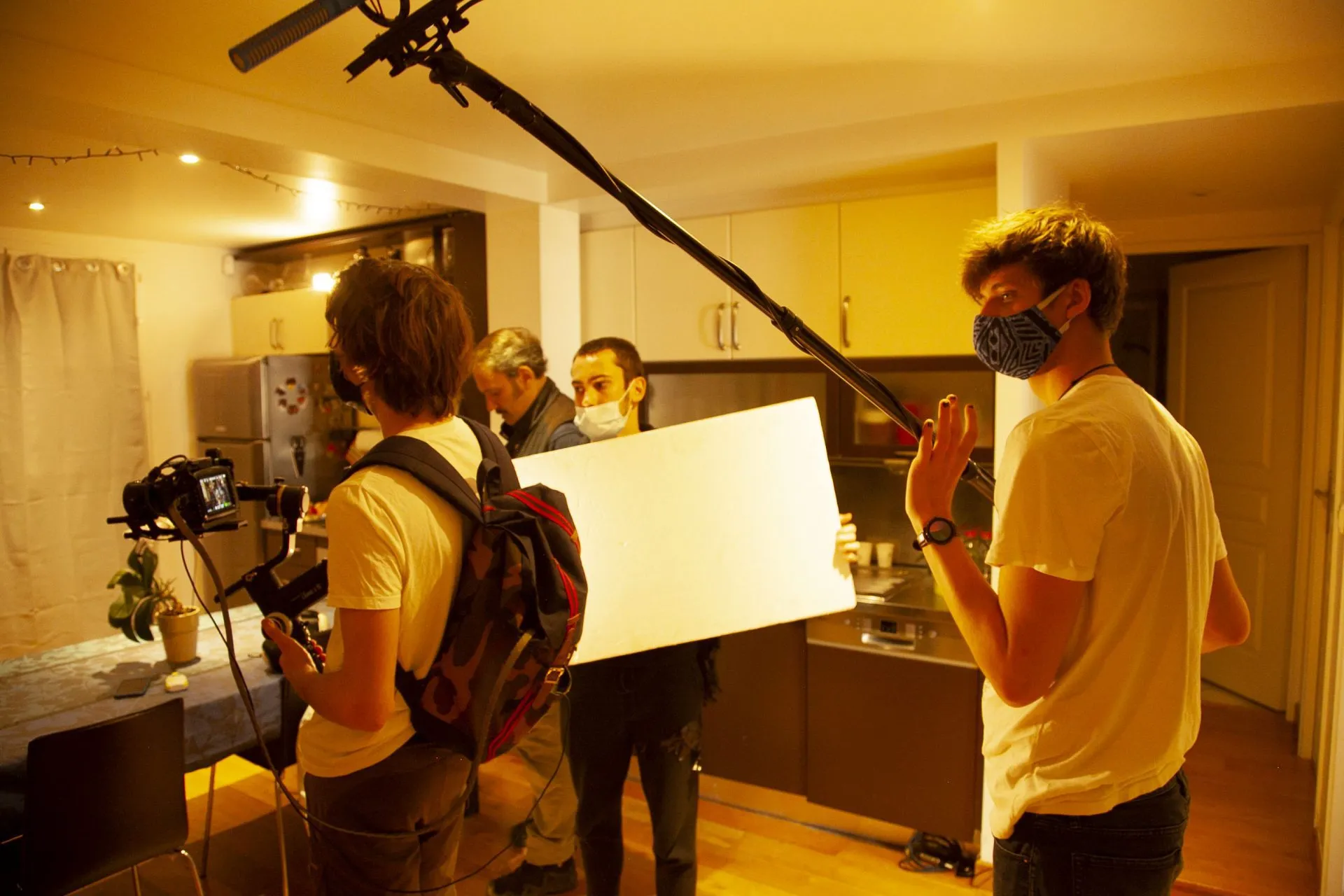
On a film set, the term “director of photography” generally refers to the cinematographer, also known as the director of photography: he or she is responsible for lighting and framing. The sound director of photography is responsible for everything that can be heard.
The two work side by side and are constantly adjusting: the boom mic must get close to the actors without entering the frame or casting a shadow in the light. A wide shot with several actors, for example, often requires ditching the boom mic in favor of wireless mics.
Who does the sound director work with?
He directs the boom operator, who positions the microphone as close as possible to the voices, and works with the director, the first assistant director—who organizes the set—and the director of photography. He also works with the script supervisor, who notes the takes that are selected, and with the camera crew, whose footage is synchronized with his own using timecode.
After filming, the audio recordings are sent to the sound editor and then to the sound mixer, who create the final soundtrack. In the film industry, the César Award for Best Sound recognizes all three of these stages—from on-set recording to mixing.
What skills do you need to become a sound engineer?
The job relies on active listening and a solid understanding of the equipment: microphones, multitrack recorders, wireless systems, and radio frequencies, as well as synchronization with the camera via timecode. It’s also essential to understand the acoustics of a venue in order to anticipate where problems might arise before they occur.
Finally, it takes diplomacy and the ability to think on your feet: the sound must find its place without slowing down a shoot where the visuals often take precedence. Knowing how to get one more take—or a few seconds of silence to capture the atmosphere of a set—is part of the job.
How much does a sound engineer earn?
For a feature film, the standard minimum wage for a sound director is €1,930.06 gross per week, based on a 39-hour workweek.
| Position and Location | Weekly minimum | Supplement |
|---|---|---|
| Film Sound Director, General Schedule | €1,930.06 gross, based on a 39-hour workweek | No |
| Film Sound Engineer, Low-Budget Film (Appendix III) | €1,249.62 gross, based on a 39-hour workweek | €1,360.87 in revenue-sharing payments |
| First sound assistant, or boom operator | €1,278.27 gross, based on a 39-hour workweek | No |
| Second Sound Assistant | €959.77 gross, based on a 39-hour workweek | No |
These amounts are taken from the salary scale of the collective bargaining agreement for film production (IDCC 3097), as established by the amendment of January 23, 2024, and remain unchanged for these positions in the scale in effect since May 1, 2026. Appendix III is an optional plan reserved for films with limited budgets, where the salary is reduced and supplemented by a profit-sharing arrangement.
These are minimum figures, subject to upward negotiation. Annual income depends primarily on the number of weeks spent on set: according to France Travail, 98% of hires in sound recording professions are fixed-term contracts lasting less than one month (data from Acoss and MSA, third quarter of 2025). Between film projects, a technician may be eligible for compensation as a freelance entertainment worker if they have worked at least 507 hours over the past twelve months, according to the France Travail guide for freelance entertainment workers. Television drama, documentaries, and commercials are governed by other collective bargaining agreements, each with their own pay scales.
What kind of education do you need to become a sound engineer?
You learn the trade through sound training and then on film sets, where you often start as a second assistant or boom operator before becoming the head of the sound crew.
At ESRA, the ESRA Sound program is a three-year course of study leading to a state-accredited “ degree ” degree at the Bac+3 level, with more than 700 hours of instruction per year. After two years of core courses common to all sound professions, the third-year audiovisual sound specialization covers on-set sound recording, sound editing, 7.1 mixing, and sound design. The projects, which increase in difficulty, culminate in the third year with productions carried out under professional conditions. The program is offered on campuses in Paris, the French Riviera, Brittany, and Brussels.
What career opportunities and prospects are there?
Sound engineers work in film, television drama, series, documentaries, and advertising, most often as freelance entertainment industry workers. Film remains a major career path: the CNC approved 290 films in 2025, including 228 French-produced films, of which 173 were dramas.
The career path generally follows the sequence of second assistant, boom operator, and then sound director. Pascal Armant (ESRA 1983) is a prime example: a boom operator starting in 1985 and a on-set sound engineer since 1990, he has been nominated three times for the César Award for Best Sound—for *Intouchables* in 2012, *Le Sens de la fête* in 2018, and *En fanfare* in 2025. Laurent Benaïm (ESRA 1998), the sound director for Louis Garrel’s *L’Innocent*, was also nominated for a César Award for Best Sound in 2023.
Some then move on to post-production, working as sound editors or mixers. In television and news reporting, a related position is thatof a sound recordist.
Sources: Légifrance, collective bargaining agreement IDCC 3097; France Travail, job description L1508 and guide for intermittent workers in the performing arts, July 2026; Arcep; CNC, 2025 Film Production Observatory; Académie des César. Verified on September 24, 2026.
Frequently Asked Questions
Are "director of photography" and "sound director" the same job?
No. Unless otherwise specified, the cinematographer is generally the director of photography, who is responsible for lighting and framing. The sound recordist is responsible for recording sound during filming.
How much does a sound engineer earn?
For a feature film, the standard minimum wage is €1,930.06 gross per week, based on a 39-hour workweek, according to the January 23, 2024, amendment to the collective bargaining agreement for film production. This minimum wage is negotiable upward.
What equipment does a sound engineer use?
A multitrack recorder, directional microphones mounted on booms, wireless microphones worn by the actors, headphones, and a timecode system to synchronize the audio with the camera. In France, wireless microphones primarily use the 470 to 694 MHz band.
Can you become a sound director after working as a boom operator?
Yes, that's the most common career path. Pascal Armant, an ESRA alumnus who has been nominated three times for a César Award for Best Sound, started out as a boom operator in 1985 before becoming a sound engineer on film sets in 1990.
Do you have to be a freelance entertainment worker to be a sound engineer?
This is the most common scenario, since hiring is done on a per-film basis: in sound recording professions, 98% of contracts are fixed-term contracts lasting less than one month. To be eligible for benefits between contracts, a technician must demonstrate at least 507 hours of work over the past twelve months.
Does the sound director also work in television?
Yes, on fiction films, TV series, and documentaries. These productions are governed by collective bargaining agreements other than those for feature films. In news reporting and on television sets, the closest equivalent position is that of sound recordist.
The other cinema jobs

Audiovisual


Live


Programs offered at ESRA Paris
The school offers post-baccalaureate Programs in all three audiovisual fields. These Programs award a state-approved degree recognized by the French Ministry of Higher Education and Research.
Producer, Director, Editor
Audiovisual, Sound Systems, Music,
Radio, Video Games
Animation, 3D Compositing & VFX, Management & Production, Modeling
Master's-level Programs also on offer
Develop your technical and creative skills in the film industry with the Master DHEC, a state-approved degree .
To become a film producer, distributor, programmer, seller or buyer
Audiovisual, Live, Music,
Radio, Sound Design
DHEC Filmmaking
in English
To manage the entire production of a project: script writing, locations, casting...