
A sound engineer specializing in live sound and recording captures, records, and broadcasts the sound of a concert, a performance, or a studio session. They select and position microphones, adjust the mixing console, and ensure that the audience, listeners, or the camera’s microphone receive clear, balanced sound without exceeding permitted sound levels.
In a nutshell
- In live sound, he handles the sound for concerts, shows, and events from the front-of-house console.
- During recording, he captures vocals and instruments in the studio or live, for a record, radio broadcast, or video recording.
- In the private performing arts sector, the standard minimum wage is €2,658.78 gross per month for a 35-hour workweek, in a venue with fewer than 300 seats.
- 98% of hires are on contracts lasting less than one month: most sound engineers are freelance performers.
- France Travail classifies it as a managerial position, under ROME code L1508.
What does a sound engineer do in broadcasting and recording?
He handles the entire audio chain, from the microphone to the speakers or the recorded file. Before the event, he reviews the artist’s technical specifications, prepares the lineup, the stage layout, and the equipment. On site, he analyzes the venue’s acoustics, sets up and calibrates the sound system, runs sound checks with the musicians, and then mixes live during the concert.
In the studio, the same job is done differently: choosing and positioning microphones, adjusting preamps, recording track by track or live, and then performing an initial sound balance before mixing and mastering.
At concerts, he is also responsible for controlling the sound level. The Public Health Code prohibits exceeding, at any point accessible to the public, 102 A-weighted decibels and 118 C-weighted decibels on average over a 15-minute period, and 94 and 104 decibels, respectively, for a performance intended for children under six years of age. In venues with more than 300 seats, these levels must be displayed continuously near the sound console and recorded.
Broadcast or recording: What's the difference?
Broadcasting involves playing sound live for an audience: this is sound reinforcement. Recording involves capturing that sound so it can be listened to later. The former happens in a single take; the latter allows for retakes.
During live performances, the role is often split into two:the front-of-house sound engineer mixes the sound sent to the audience, whilethe stage sound engineer manages the monitor signals that the musicians hear on stage. In the studio or during a recording session, the term “sound engineer” or“recording engineer” is more commonly used.
Who does a sound engineer work with?
During performances, he works with the sound stage manager, who coordinates the equipment and crew, with the stage manager, and with the sound technicians who set up the speakers and run the cables. He is in constant communication with the performers during sound checks.
In the studio, he works with the artist, the artistic director, or the producer, and often with an assistant who sets up the microphones and manages the sessions. For a recording, he coordinates with the director and the camera crew. France Travail notes that he also trains assistants and new team members.
What skills do you need to become a sound engineer?
It requires a trained ear—one capable of identifying a disruptive frequency or an instrument that’s too prominent—as well as a solid technical foundation in acoustics, microphones, digital mixing consoles, software such as Pro Tools, electrical systems, and audio cabling. Among the key skills, France Travail lists analyzing a venue’s acoustics, managing interference and background noise, and complying with noise safety standards.
Live broadcasting requires a cool head: a microphone that cuts out or feedback can be fixed in a matter of seconds, right in front of the audience. The job also requires flexibility, with irregular hours, outdoor work, and tours.
How much does a sound engineer earn?
In the private performing arts sector, the standard minimum wage for a sound engineer is €2,658.78 gross per month for a 35-hour workweek in a venue with fewer than 300 seats, and €2,928.75 in a venue with more than 300 seats.
| Position and Location | Minimum Gross Monthly Wage | Hourly rate |
|---|---|---|
| Sound engineer, venue with fewer than 300 seats | 2 658,78 € | 17,53 € |
| Sound engineer, venue with more than 300 seats | 2 928,75 € | 19,31 € |
| Sound Engineer on Tour | 3 074,35 € | 20,27 € |
| Sound engineer, mixing console technician, or sound supervisor, for venues with fewer than 300 seats | 2 115,80 € | 13,95 € |
| Sound Technician, venue with fewer than 300 seats | 1 906,49 € | 12,57 € |
These amounts are taken from the technician pay scale in the appendix covering song, variety, jazz, and contemporary music performances in the collective bargaining agreement for the private performing arts sector (IDCC 3090): amendment of July 21, 2025, effective as of September 1, 2025, and extended by decree of February 17, 2026. These are minimum rates, which may be negotiated upward.
According to France Travail, 80% of sound engineer job postings on the market offer between €1,802 and €2,300 gross per month (first quarter of 2026), based on 1,740 postings over a 12-month period. However, the vast majority of work in this field is performed under short-term contracts: 98% of hires are fixed-term contracts lasting less than one month, according to Acoss and MSA data from the third quarter of 2025 cited by France Travail. Earnings therefore depend primarily on the number of days worked, supplemented by compensation for intermittent workers in the entertainment industry.
What kind of education do you need to become a sound engineer?
According to France Travail, entry into this profession requires a two- to five-year degree in sound, audiovisual media, or music technology, or a high school diploma ( degree ) supplemented by substantial experience. In practice, people often start out as technicians or assistants before moving on to the mixing console.
At ESRA, the ESRA Sound program is a three-year course leading to a state-accredited “ degree ” degree (equivalent to a bachelor’s degree). The first two years cover all aspects of the sound industry. In the third year, students choose one of five specializations: audiovisual sound, music, live sound, radio, and video games. The live sound specialization prepares students for sound reinforcement at live performances and events, while the music specialization focuses on sound recording and studio mixing.
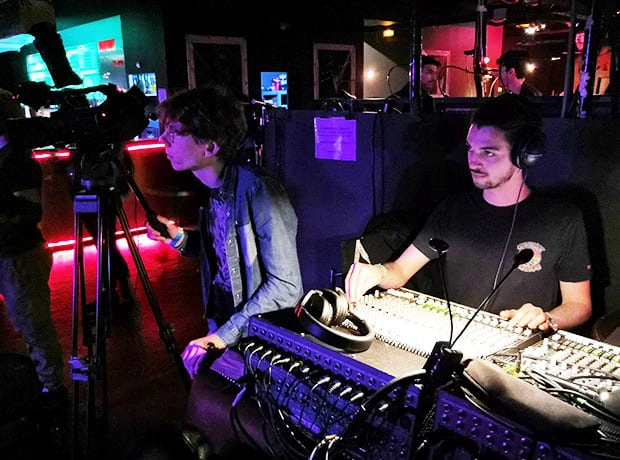
Students gain real-world experience before completing their program: at theESRA Sound Night at the New Morning in Paris, third-year sound engineering students run the concert’s sound booth, while television production students handle the recording. The program is offered at campuses in Paris, the French Riviera, Brittany, and Brussels.
What career opportunities and prospects are there?
Sound engineers work for concert venues, festivals, theaters, sound companies, recording studios, radio stations, and television networks. To be eligible for compensation as a freelance entertainment worker, a technician must provide proof of at least 507 hours of work over the previous twelve months, according to the France Travail guide for freelance entertainment workers.
Career paths lead toward touring, sound engineering, technical direction, or toward the studio, mixing, and sound design. Several ESRA alumni have gone on to achieve great success: Pascal Armant (ESRA 1983) has received three César Award nominations for Best Sound, including for *Intouchables*; Antoine Chabert (ESRA 1994) mastered Daft Punk’s *Random Access Memories*, which won three Grammy Awards in 2014.
Sources: France Travail, job description L1508 and data from the first quarter of 2026; Légifrance, collective bargaining agreement IDCC 3090 and Article R1336-1 of the Public Health Code; France Travail guide for freelance entertainment workers, July 2026. Verified on September 24, 2026.
Frequently Asked Questions
Do you need a " degree " to become a sound engineer?
No, there are no legally required educational degree s. France Travail states that this profession is open to individuals with a two- to five-year post-secondary degree in sound or audiovisual studies, or with a high school diploma ( degree ) supplemented by substantial experience. In practice, employers primarily hire candidates with formal training.
How much does an entry-level sound engineer earn?
In the private performing arts sector, the collectively agreed minimum wage applies from the very first contract: €2,658.78 gross per month for 35 hours per week in a venue with fewer than 300 seats, according to the amendment of July 21, 2025. Of the job postings on France Travail, 80% offer between €1,802 and €2,300 gross per month.
Do you have to be a freelance performer to be a sound engineer?
It is not mandatory, but it is the most common scenario: 98% of hires are for fixed-term contracts lasting less than one month. To be eligible for unemployment benefits between contracts, a technician must have worked at least 507 hours over the past twelve months.
What is the difference between a facade engineer and a returns engineer?
The front-of-house engineer mixes the sound that the audience hears from a console located in the venue. The monitor engineer, or stage sound engineer, mixes what each musician hears through their monitors or headphones from the edge of the stage.
What is the maximum permitted noise level at a concert?
The Public Health Code sets the limit at 102 A-weighted decibels and 118 C-weighted decibels, averaged over 15 minutes, at any point accessible to the public. For a performance intended for children under six years of age, the limit is reduced to 94 and 104 decibels.
Where can you study to become a sound engineer in Belgium?
The ESRA Sound program, which prepares students for a career as a sound engineer over the course of three years, is also offered at the ESRA campus in Brussels.
The other cinema jobs

Audiovisual


Live


Programs offered at ESRA Paris
The school offers post-baccalaureate Programs in all three audiovisual fields. These Programs award a state-approved degree recognized by the French Ministry of Higher Education and Research.
Producer, Director, Editor
Audiovisual, Sound Systems, Music,
Radio, Video Games
Animation, 3D Compositing & VFX, Management & Production, Modeling
Master's-level Programs also on offer
Develop your technical and creative skills in the film industry with the Master DHEC, a state-approved degree .
To become a film producer, distributor, programmer, seller or buyer
Audiovisual, Live, Music,
Radio, Sound Design
DHEC Filmmaking
in English
To manage the entire production of a project: script writing, locations, casting...


