
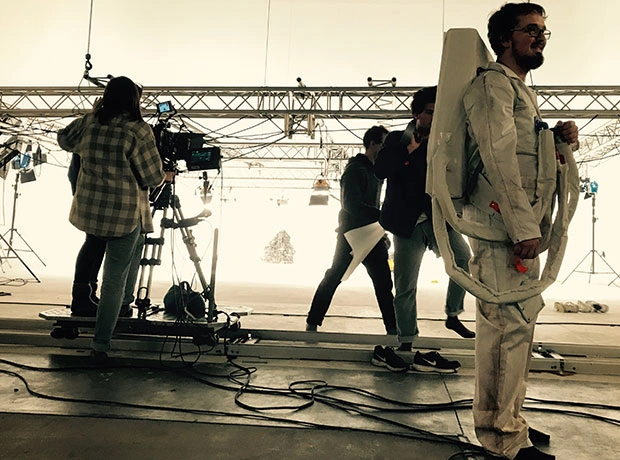
The chief rigger builds and operates the camera rigs: dolly tracks, cranes, jibs, and platforms. He also sets up the structures that support the projectors. This is the role that makes the director’s intended camera movements physically possible.
In a nutshell
- He operates the camera movements: tracks, dollies, cranes, and stabilizers.
- He sets up the structures and mounts that hold the spotlights and backdrops.
- He is responsible for the safety of everything that is suspended or at a height.
- Standard minimum wage for a feature film: €1,211.99 gross per week, based on a 39-hour workweek.
- Exact title as defined in the collective bargaining agreement: Chief Cinematographer, Title II of the collective bargaining agreement.
- ICD Code: L1506, stage machinery.
What does a chief grip do on a film set?
The chief rigger designs and sets up the mechanical equipment needed to position and move the camera exactly as the shot requires. Every movement on screen corresponds to a rig he has built.
During preparation, he reads the storyboard, identifies the sets, assesses what each movement requires in terms of tracks, elevation, or a crane, and orders the equipment. On set, he lays the tracks, levels them, operates the dolly or crane during the take, and dismantles the setup to reinstall it elsewhere, often within a very short time frame.
He also works on everything that’s up high: structures for spotlights, platforms, backdrops, and safety barriers. This is the safety aspect of the job, and it’s crucial.
This focus on safety also involves certifications: for machinery-related occupations, France Travail recommends various CACES certifications—certificates of competence for operating forklifts, mobile cranes, and aerial work platforms.
Chief Stage Technician or Chief Electrician: What's the Difference?
The chief stage technician is in charge of mechanics and set structures, while the chief electrician handles lighting and power. The two departments are separate but work together constantly.
When a projector needs to be hung five meters up, the electrician chooses the light source and the stagehand builds the rig to hold it. When the camera needs to be lowered down a flight of stairs, the stagehand comes up with the mechanical solution. On Anglo-Saxon sets, the term “grip” refers to the stagehands, and “gaffer” refers to the electricians.
Under the same collective bargaining agreement, the two positions are paid the same, which clearly indicates that they are of equal rank within the studio hierarchy.
Who does the chief stage manager work with?
He works with the director of photography and the camera operator on camera movements, and constantly collaborates with the chief electrician on all lighting setups.
He leads a team of camera operators, coordinates with the first assistant director regarding setup time, with the production manager regarding rented equipment, and with the set department whenever a shot requires modifying a set platform or floor.
What skills do you need to become a chief machinist?
The job combines practical mechanical knowledge, an understanding of film production, and responsibility for the safety of others.
- Mechanics. Understanding loads, supports, and levels, and coming up with a safe solution using whatever is available.
- Movement. Understanding the effect a tracking shot or a crane shot has on the image, so you can take the initiative rather than be at the mercy of it.
- Safety. Nothing should be able to fall. It’s the only area on set where a mistake could have serious consequences.
- The pace. Install and uninstall quickly, several times a day, without damaging anything.
How much does a chief machinist earn?
On a feature film, the standard minimum wage for a chief camera operator is €1,211.99 gross per week, based on a 39-hour workweek—exactly the same pay scale as that for a chief electrician.
| Location | Weekly minimum | Supplement |
|---|---|---|
| Feature Film, General Schedule | €1,211.99 gross, based on a 39-hour workweek | — |
| Low-Budget Film, Appendix III | €983.93 gross, based on a 39-hour workweek | €456.10 in revenue-sharing payments |
These amounts are taken from the pay scale in the collective bargaining agreement for film production (IDCC 3097), under the heading “Chief Camera Operator.” Appendix III is an optional plan reserved for films with a limited budget, where the salary is reduced and supplemented by a profit-sharing arrangement. Verified on September 15, 2026.
These are minimum rates, which can be negotiated upward for large budgets. Advertising and television drama are covered by other collective bargaining agreements.
Under the same pay scale, in effect since May 1, 2026, a camera operator earns €1,009.05 and a set construction foreman, who works on built sets, earns €1,265.63 gross per week, based on a 39-hour workweek. The work remains intermittent: according to France Travail, 97% of hires in the rigging trades (ROME code L1506) are fixed-term contracts of less than one month (data from Acoss and MSA, third quarter of 2025), and 80% of job postings offered between €1,802 and €2,308 gross per month in the first quarter of 2026.
What kind of education do you need to become a chief machinist?
It’s a trade that’s learned almost entirely on set, starting as a stagehand and then moving on to assistant director, without having to go through a “ degree.”
Training in audiovisual production provides an understanding of visual culture and the vocabulary of the set, which saves years in learning to understand the purpose of a camera movement. A technical background—in structures, rigging, and construction—provides a solid foundation in mechanics. In both cases, skills are developed as part of a team, through mentorship.
At ESRA, the ESRA Cinema program is a three-year course of study leading to a state-accredited “ degree ” degree at the Bac+3 level, with more than 700 hours of instruction per year and at least two productions per year, screened before a jury—providing ample opportunity to gain hands-on experience in all roles within the cinematography department, including dolly and crane operations. After two years of core curriculum, the third-year cinematography specialization focuses on cameras, lighting, and framing. The program is offered in Paris, on the French Riviera, in Brittany, and in Brussels.
What career opportunities and prospects are there?
Work in this field is intermittent and relies on the loyalty of the cinematography crews: a chief gaffer is rehired by the same directors of photography from one film to the next. Employers include film, television, advertising, and music video production companies.
The trend is mainly toward a wider range of projects, with films that feature more ambitious equipment setups. Some specialize in stabilized camera heads, remote-controlled cranes, or camera vehicles, while others join rental and production service companies, where on-set experience is highly valued.
Sources: Légifrance, IDCC 3097 collective bargaining agreement, pay scale effective as of May 1, 2026; France Travail, ROME code L1506. Verified on September 24, 2026.
Frequently Asked Questions
What exactly does a stagehand do at a movie theater?
He builds and operates all equipment used to support or move the camera—including tracks, dollies, and cranes—and installs the structures that hold the lights and backdrops. The chief rigger heads this department.
How much does a chief machinist earn?
For a feature film, the standard minimum wage is €1,211.99 gross per week based on a 39-hour workweek, for the position of chief camera operator. This is the same pay scale as that for the chief electrician.
How is this different from the chief electrician?
The stagehand handles the rigging and mechanics, while the electrician handles the lighting and power. When a spotlight needs to be hung high up, the electrician chooses the light source and the stagehand builds the structure to hold it.
Do you need a " degree " to become a stagehand?
No, you learn the trade on set, starting as a stagehand and then moving up to assistant director. Training in film and television helps you understand the purpose of a camera movement, which allows you to propose solutions rather than just carrying them out.
Is it a dangerous job?
He is responsible for everything that is suspended or elevated on a set, so safety is of the utmost importance. This is the area where there is absolutely no room for error.
Are a stagehand and a grip the same thing?
Yes. "Grip" is the English term for set machinery, and " key grip " refers to the head gripper.
The other cinema jobs

Audiovisual


Live


Programs offered at ESRA Paris
The school offers post-baccalaureate Programs in all three audiovisual fields. These Programs award a state-approved degree recognized by the French Ministry of Higher Education and Research.
Producer, Director, Editor
Audiovisual, Sound Systems, Music,
Radio, Video Games
Animation, 3D Compositing & VFX, Management & Production, Modeling
Master's-level Programs also on offer
Develop your technical and creative skills in the film industry with the Master DHEC, a state-approved degree .
To become a film producer, distributor, programmer, seller or buyer
Audiovisual, Live, Music,
Radio, Sound Design
DHEC Filmmaking
in English
To manage the entire production of a project: script writing, locations, casting...


