
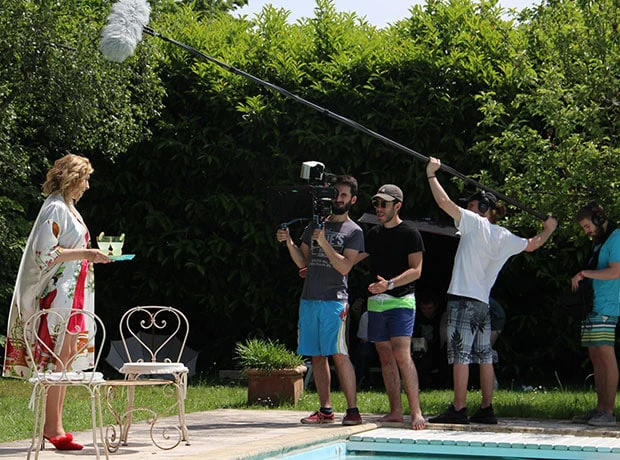
The boom operator holds the boom pole and positions the microphones to capture dialogue during filming. It is a job that requires physical precision: the microphone must be as close as possible to the voices, yet invisible on camera.
In a nutshell
- He captures dialogue as closely as possible, using a boom mic or wireless microphones placed on the actors.
- He works under the supervision of the sound engineer, who records and monitors the sound level.
- The standard job title is First Assistant Sound Engineer. On a feature film, the minimum pay is €1,278.27 gross per week, based on a 39-hour workweek.
- He is hired on a per-film basis: in the sound recording field, 98% of hires are for fixed-term contracts lasting less than one month.
- This position is also known as a boom operator or sound assistant. ROME code: L1508, sound recording and sound reinforcement.
What does a perchman do on a film set?
The boom operator positions and moves the microphones during the take so that every line is picked up clearly, without ever entering the frame or casting a shadow. This is the key part of on-location sound recording.
Before the take, he marks out the shot with the cinematographer, listens to the dialogue breakdown, chooses his key positions, and decides whether to use a boom mic or equip the actors with wireless mics. During the take, he follows the actors’ movements and lines—often with his arms raised for several minutes at a time—anticipating who will speak next.
He also sets up the equipment with the sound crew: microphones, windshields, mounts, transmitters, and batteries. For wireless microphones, they have to find available frequencies on each set: in France, they mainly use the 470–694 MHz band, without individual authorization but within the power limits set byArcep.
Perchman or sound engineer: What's the difference?
The sound director records and is responsible for the film’s sound quality, while the boom operator captures the sound. One is on the dolly with the recorder, and the other is on set with the boom.
The sound director selects the equipment, monitors the levels, decides whether a take is good from a sound perspective, and communicates with the director. The boom operator handles the recording and suggests microphone placements. They are the closest-knit duo on set, and moving from boom operator to sound director is the standard career progression.
Also worth distinguishing from post-production roles: the sound editor and the sound mixer work after filming is complete, on the audio recorded by the boom operator.
Who does the boom operator work with?
He works alongside the sound director, and sometimes with a second sound assistant on large productions, and is in constant dialogue with the visuals.
The camera operator shows him the frame boundaries, the gaffer warns him about shadows his boom might cast, the first assistant director gives him time to set up, and the actors decide whether or not to wear wireless microphones under their costumes—which requires tact when dealing with the costume department.
What skills do you need to become a boom operator?
It's a profession that relies on both the ear and the body, where endurance is just as important as technique.
- Listening: hearing what the microphone picks up, not what the ear wants to hear.
- The setting: Know the focal lengths to determine how far into the frame the boom will extend.
- Anticipation: knowing by heart who is speaking when, so you’re already tuned in to the right voice.
- Physical fitness: holding the pole with arms raised, motionless and silent, take after take.
This physical strain is closely monitored: freelance performing artists are covered by a cultural-sector-specific occupational health service, Thalie Santé, which was created in 2021 through the merger of the Centre Médical de la Bourse and the Centre Médical de la Publicité et de la Communication.
How much does a perchman earn?
On a film set, the standard minimum wage for a boom operator—whose official title is first assistant sound engineer—is €1,278.27 gross per week, based on a 39-hour workweek.
| Position and Location | Weekly minimum | Supplement |
|---|---|---|
| Perchman (First Assistant Sound Engineer), General Schedule | €1,278.27 gross, based on a 39-hour workweek | No |
| "Perchman," a low-budget film (Appendix III) | €1,008.46 gross, based on a 39-hour workweek | €539.61 in revenue-sharing payments |
| Second Sound Assistant | €959.77 gross, based on a 39-hour workweek | No |
| Sound Director, for comparison | €1,930.06 gross, based on a 39-hour workweek | No |
These amounts are taken from the salary scale of the collective bargaining agreement for film production (IDCC 3097), as established by the amendment of January 23, 2024, and remain unchanged for these positions in the scale in effect since May 1, 2026. Appendix III is an optional plan reserved for films with limited budgets, where the salary is reduced and supplemented by a profit-sharing arrangement.
These are minimum figures, which can be negotiated upward. Annual income depends primarily on the number of weeks spent on set: according to France Travail, 98% of hires in sound recording professions are fixed-term contracts lasting less than one month (data from Acoss and MSA, third quarter of 2025). Between film projects, a technician may be eligible for benefits as a freelance entertainment worker if they have worked at least 507 hours over the past twelve months, according to the France Travail guide for freelance entertainment workers. Television drama, advertising, and documentaries are governed by other collective bargaining agreements, each with their own pay scales.
What kind of education do you need to become a boom operator?
You learn the job through sound training and then on set, where you often start as a second assistant before moving on to operating the boom.
The profession requires a solid technical foundation—in acoustics, microphones, and the recording chain—which specialized training provides more quickly than self-study. The rest takes place on set, where one’s reputation is built on the quality of the takes and the ability to never waste time.
At ESRA, the ESRA Sound program is a three-year course of study leading to a state-accredited “ degree ” degree (equivalent to a three-year post-secondary program), with more than 700 hours of instruction per year. After two years of core courses common to all sound professions, the third-year audiovisual sound specialization covers on-set sound recording, sound editing, 7.1 mixing, and sound design. The program is offered on campuses in Paris, the French Riviera, Brittany, and Brussels.
What career opportunities and prospects are there?
This profession is most often practiced on a freelance basis, and the consistency of work depends on the sound director, who brings the same boom operator with him from one film to the next: it’s a role where the partnership between the two is crucial.
The natural progression is the position of chief sound engineer. Pascal Armant (ESRA 1983) followed this path: starting as a boom operator in 1985 and working as a on-set sound engineer since 1990, he has been nominated three times for the César Award for Best Sound—for *Intouchables* in 2012, *Le Sens de la fête* in 2018, and *En fanfare* in 2025. Others turn to sound editing, mixing, or documentary sound, where one person often handles the entire production chain alone.
Sources: Légifrance, collective bargaining agreement IDCC 3097; France Travail, job description L1508 and guide for freelance entertainment workers, July 2026; Arcep; Thalie Santé; Académie des César. Verified on September 24, 2026.
Frequently Asked Questions
Why use a boom mic instead of wireless microphones?
A boom mic produces a more natural sound because the microphone is directional and positioned above the singer’s voice, without any clothing rubbing against it. Wireless microphones are used as a supplement, or when it’s impossible to position the boom mic without it appearing in the frame—for example, in a wide shot.
How much does a perchman earn?
On a feature film, the standard minimum wage is €1,278.27 gross per week, based on a 39-hour workweek, for the position of first assistant sound engineer, according to the January 23, 2024, amendment to the collective bargaining agreement for film production. This minimum wage is negotiable upward.
Perchman, pole vaulter, or sound assistant?
All three terms refer to the same position. The collective bargaining agreement uses the term “first sound assistant”; on set, the person is called a “perchman” or “perchist.” France Travail classifies it under ROME code L1508, sound recording and sound reinforcement.
Do you have to be a freelance performer to be a boom operator?
This is the most common scenario, since hiring is done on a per-film basis: in sound recording professions, 98% of contracts are fixed-term contracts lasting less than one month. To be eligible for benefits between contracts, a technician must demonstrate at least 507 hours of work over the past twelve months.
Is it a physically demanding job?
Yes. The boom operator holds the boom with his arms raised—sometimes for several minutes at a time—without making a sound or shaking, and remains on his feet all day. Freelance performing arts workers receive health care through Thalie Santé, the occupational health service for the cultural sector.
Can you become a sound engineer later on?
Yes, that’s the most common career path. Pascal Armant, an ESRA alumnus who has been nominated three times for a César Award for Best Sound, started out as a boom operator in 1985 before becoming a sound engineer on set in 1990.
The other cinema jobs

Audiovisual


Live


Programs offered at ESRA Paris
The school offers post-baccalaureate Programs in all three audiovisual fields. These Programs award a state-approved degree recognized by the French Ministry of Higher Education and Research.
Producer, Director, Editor
Audiovisual, Sound Systems, Music,
Radio, Video Games
Animation, 3D Compositing & VFX, Management & Production, Modeling
Master's-level Programs also on offer
Develop your technical and creative skills in the film industry with the Master DHEC, a state-approved degree .
To become a film producer, distributor, programmer, seller or buyer
Audiovisual, Live, Music,
Radio, Sound Design
DHEC Filmmaking
in English
To manage the entire production of a project: script writing, locations, casting...


