The chief electrician sets up the lighting designed by the director of photography and provides power to the set. He is the head of the electrical department, and his is one of the few jobs in the film industry where a mistake can be dangerous.
In a nutshell
- He implements the lighting as directed by the director of photography; he does not design it.
- He is responsible for the power supply to the set and the safety measures associated with it.
- Standard minimum wage for a feature film: €1,211.99 gross per week, based on a 39-hour workweek.
- Exact title as defined in the collective bargaining agreement: Chief Electrician for Film Production, Title II of the collective bargaining agreement.
- You can advance to this position after several years as an electrician and then as an assistant chief electrician.
- ROME Code: L1504, stage lighting. An electrical permit is required.
What does a chief electrician do on a film set?
The chief electrician sets up the lighting fixtures and power supply required for each shot, in accordance with the director of photography’s vision. The CPNEF for the audiovisual sector summarizes the role as follows: the chief electrician manages all power supply for a set and sets up the lighting for scenes in collaboration with the director of photography.
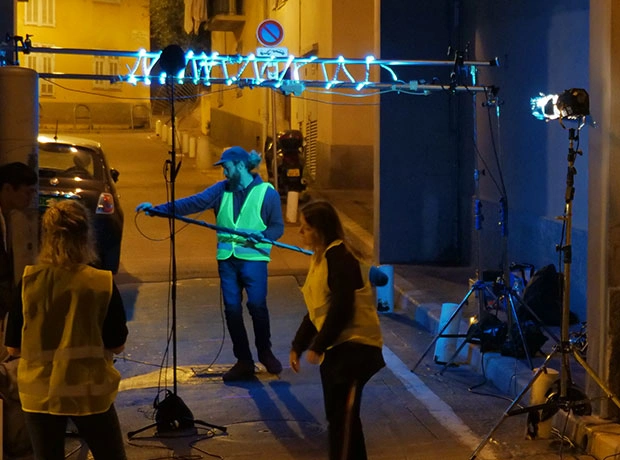
During pre-production, he surveys the sets with the director of photography, assesses the available power, orders equipment—including projectors, gel filters, stands, and generators—and determines the size of his crew. On set, he positions the light sources, adjusts the intensity, manages lighting changes between shots, and anticipates the next shot while the previous one is being filmed.
He is also responsible for electrical safety on set: ensuring that installations comply with regulations, protecting circuits, managing wiring, monitoring heat from light sources, and ensuring the safety of people around the equipment. This is the least visible—and least negotiable—aspect of the job.
This responsibility is governed by law: according toArticle R4544-9 of the Labor Code, work on electrical installations or in their vicinity may only be performed by authorized workers. France Travail specifies that authorization to work with electrical hazards is required for lighting-related occupations.
Chief Electrician or Director of Photography: What's the Difference?
The director of photography decides on the lighting; the chief electrician sets it up. One is a creative role; the other involves implementation and team leadership.
The director of photography defines the film’s visual style in collaboration with the director: lighting approach, contrasts, colors, and lens selection. The gaffer translates these intentions into practical implementation, working within the constraints of available equipment, time, and power. On set, the director of photography’s direction is an artistic intention, while the gaffer’s decision is a technical one.
Don't confuse him with the chief rigger, who handles the supports, camera movements, and structures, whereas the chief electrician handles the lighting and power. The two departments work together as a permanent team.
Who does the chief electrician work with?
He is the director of photography’s technical right-hand man and the head of a team that includes—depending on the scale of the film—an assistant gaffer, several camera electricians, and a generator operator.
He is in constant communication with the chief gaffer, the first assistant director—whose shooting schedule determines the setup time available to him—and the production manager regarding the equipment budget and crew hours. On location, he also deals with property owners and energy suppliers.
What skills do you need to become a master electrician?
The job relies on three skills that aren't all learned in the same place: lighting, electricity, and team leadership.
- Light. Understanding a photographic intention and knowing how to achieve it: color temperature, diffusion, lighting angles, illuminance ratio, and continuity between shots.
- Electricity. Power calculations, distribution, protection, generators, safety standards. This is the area where there’s no room for error.
- Equipment. Be familiar with projectors, LEDs, tripods, and mounting hardware, and know what you can achieve with what’s on the truck rather than with what you might have wanted.
- The team. Get the installation done quickly and correctly, even under the pressure of the work schedule, without compromising safety.
How much does a master electrician earn?
On a feature film, the standard minimum wage for the chief gaffer is €1,211.99 gross per week, based on a 39-hour workweek.
| Location | Weekly minimum | Supplement |
|---|---|---|
| Feature Film, General Schedule | €1,211.99 gross, based on a 39-hour workweek | — |
| Low-Budget Film, Appendix III | €983.93 gross, based on a 39-hour workweek | €456.10 in revenue-sharing payments |
These amounts are taken from the pay scale in the collective bargaining agreement for film production (IDCC 3097), under the heading “Chief Electrician for Film Shooting.” The second system, Appendix III, is optional and reserved for films with a limited budget: the salary is reduced and supplemented by a revenue-sharing bonus. Verified on September 15, 2026.
Two important caveats. These are minimum rates, and on a big-budget film, actual pay is negotiated at a higher level. And television and advertising are governed by other collective bargaining agreements, with their own pay scales.
Beware of a common pitfall: the pay scales published by certain unions are labeled “revised” and list amounts that are several percent higher than the minimum rates that actually apply. These are requests for retroactive adjustments, not current law.
Under the same pay scale, effective May 1, 2026, the camera electrician earns €1,009.05, the generator operator, who manages the generators, earns €1,087.48, and the construction chief electrician, who works on built sets, earns €1,265.63 gross per week, based on a 39-hour workweek. Employment remains intermittent: according to France Travail, 98% of hires in the lighting trades (ROME code L1504) are fixed-term contracts lasting less than one month (data from Acoss and MSA, third quarter of 2025).
What kind of education is required to become a master electrician?
You don’t graduate from school as a chief electrician: you work your way up to that position after several years on set, first as an electrician and then as an assistant chief electrician. The initial training is designed to help you join the cinematography department and understand its terminology.
There are two paths. The audiovisual path, through film school, where you learn about lighting, camera work, and filmmaking, and which allows you to step onto a set already understanding what goes on there. And the electrical engineering path, through an electrician’s degree , which provides expertise in electricity but leaves all the learning about filmmaking to be done on set. Both paths lead to the job; the first gets you into the cinematography department more quickly, while the second provides a more solid foundation in safety.
At ESRA, the ESRA Cinema program is a three-year course of study leading to a state-accredited “ degree ” degree at the Bac+3 level, with more than 700 hours of instruction per year and at least two productions per year, screened before a jury, with students rotating through technical roles. After two years of core courses, the third-year cinematography specialization focuses on cameras, lighting, and framing. The program is offered in Paris, on the French Riviera, in Brittany, and in Brussels.
What career opportunities and prospects are there?
Work in this field is intermittent, on a film-by-film basis, and the consistency of work depends directly on the relationship with cinematographers, who bring their teams back from one project to the next. Employers include film, television drama, advertising, and music video productions.
Two career paths stand out. One is to remain a gaffer and move up to more high-profile projects—which is the most common and highest-paying path. The other is to transition to cinematography, which requires a personal vision for imagery and a network of directors, and doesn’t happen automatically. Some also turn to lighting equipment rental and services, where on-set experience is highly valued.
Sources: Légifrance, collective bargaining agreement IDCC 3097, pay scale in effect since May 1, 2026; Labor Code, Article R4544-9; France Travail, ROME code L1504. Verified on September 24, 2026.
Frequently Asked Questions
Does the chief electrician decide on the lighting?
No. The lighting is designed by the director of photography; the chief electrician implements it, selects the technical means to achieve it, and supervises the lighting crew.
How much does a master electrician earn?
For a feature film, the standard minimum is €1,211.99 gross per week based on a 39-hour workweek, under the title “Chief Cinematography Electrician” in Title II of the pay scale. This is a minimum; actual compensation is negotiated at a higher rate on big-budget productions.
Is an electrician's " degree " required?
It’s not required, but the electrical aspect of the job can’t be winged: power calculations, distribution, circuit protection, and generators. Many chief electricians come from an electrical engineering background, while others come from film school and learn the ropes on set.
What's the difference between that and the chief machinist?
The chief electrician is in charge of lighting and the power supply, while the chief stage manager oversees the rigs, camera movements, and set structures. The two departments work together as a permanent team on set.
Does the chief electrician also work in television and advertising?
Yes, and that actually accounts for the bulk of the workload. However, these sectors are covered by collective bargaining agreements other than the one for the film industry, and they have their own pay scales.
Can you become a director of photography after that?
This is a possible career path, but it doesn't happen automatically: it requires personal development in the field and a network of directors. Many gaffers spend their entire careers as gaffers, working their way up through projects of increasing scope.
The other cinema jobs

Audiovisual


Live


Programs offered at ESRA Paris
The school offers post-baccalaureate Programs in all three audiovisual fields. These Programs award a state-approved degree recognized by the French Ministry of Higher Education and Research.
Producer, Director, Editor
Audiovisual, Sound Systems, Music,
Radio, Video Games
Animation, 3D Compositing & VFX, Management & Production, Modeling
Master's-level Programs also on offer
Develop your technical and creative skills in the film industry with the Master DHEC, a state-approved degree .
To become a film producer, distributor, programmer, seller or buyer
Audiovisual, Live, Music,
Radio, Sound Design
DHEC Filmmaking
in English
To manage the entire production of a project: script writing, locations, casting...