
The sound editor works after the footage has been edited. He or she sorts through and cleans up the audio recorded during filming, selects the best dialogue takes, adds ambient sounds, effects, and sound effects, and prepares all these tracks for mixing.
In a nutshell
- He edits the dialogue, background sounds, effects, and sound effects for a film after the footage has been edited.
- He sends clean, organized tracks to the mixer, ready to be mixed.
- On a feature film, the minimum salary for a sound editor is €1,656.25 gross per week, based on a 39-hour workweek.
- According to the CNC, 290 films were approved in 2025.
- This profession involves working in film, television series, documentaries, animation, and advertising.
What does a sound editor do?
He receives the edited film and all the audio from the shoot. He often starts with the dialogue: he searches through the other takes for a word that’s pronounced more clearly, removes background noise, and identifies the lines that need to be re-recorded in the studio during post-synchronization.
He then puts together the rest of the soundtrack: ambient sounds of locations, sound effects, and sounds from his own library or recorded specifically for the film. He instructs the sound effects artist on the sounds of footsteps, clothing, or objects that need to be re-recorded in the studio.
Finally, he organizes all these tracks so that the mixer can balance them. He works on a digital audio workstation, most often Pro Tools.
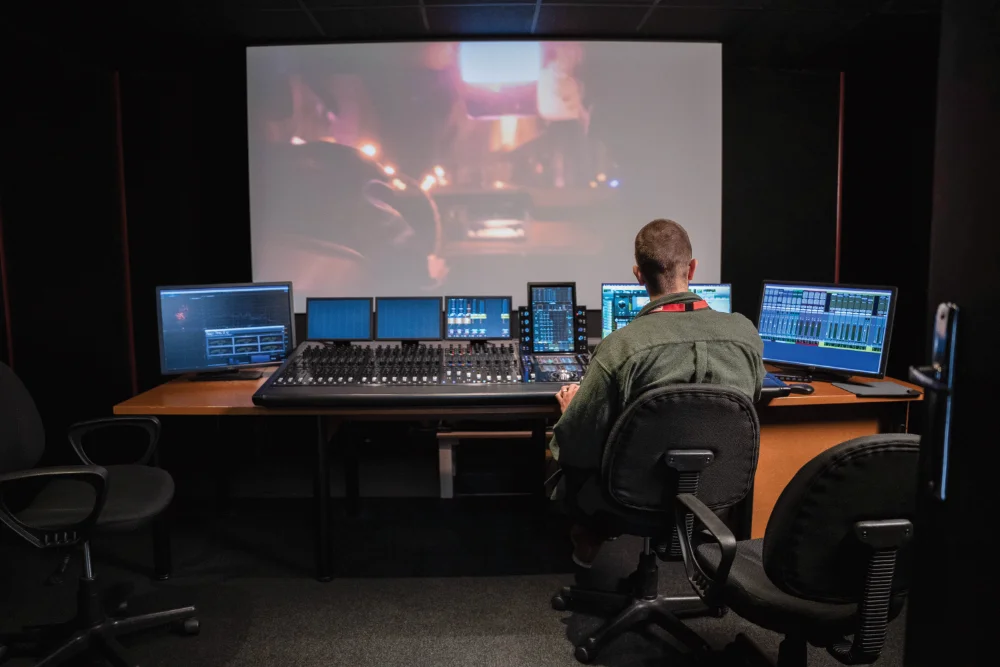
Sound editor, mixer, or sound designer: What's the difference?
The sound editor creates and prepares the audio elements. The sound mixer then blends them in the mixing room, adjusts their levels and positions them in the soundstage, and delivers the final soundtrack. The sound designer creates sounds that don’t exist for a movie, TV series, video game, or brand.
During pre-production, the sound supervisor and the boom operator record the sounds from the shoot, which the sound editor then processes. The collective bargaining agreement for the film industry distinguishes between the chief sound editor, the sound editor’s assistant, the sound effects artist, and the sound mixer.
Who does the sound editor work with?
He works with the director, who approves his decisions, and with the film editor, from whom he receives the edited film. He consults with the sound supervisor regarding the sounds recorded on set.
Down the line, he prepares the work for the sound effects artist, the post-synchronization actors, and the sound mixer. On a feature film, the work may be divided among a dialogue editor, an effects editor, and an assistant.
What skills do you need to become a sound editor?
You need a very keen ear, one that can pick up on background noise or a change in atmosphere between two shots. You also need to understand the dramatic structure: sound tells the story just as much as the image does, and a well-placed silence can transform a scene.
You need to be proficient in audio editing software, sound cleaning techniques, and delivery formats for film and television. The job requires patience and a methodical approach, since a soundtrack is built piece by piece.
How much does a sound engineer earn?
On a feature film, the minimum wage for a sound editor is €1,656.25 gross per week, based on a 39-hour workweek. The minimum wage for a sound editing assistant is €1,121.74.
| Post Office, Movie Theater | Minimum gross weekly pay, based on a 39-hour workweek | Low-Budget Film (Appendix III) |
|---|---|---|
| Head Sound Editor | 1 656,25 € | €1,148.31, plus €1,015.88 in revenue-sharing |
| Assistant Sound Editor | 1 121,74 € | €950.54, plus €342.39 |
| Sound Effects Artist | 2 110,45 € | €1,316.37, plus €1,588.17 |
| Mixer | 2 110,45 € | €1,316.37, plus €1,588.17 |
These amounts are taken from the pay scale in the collective bargaining agreement for film production (IDCC 3097), effective as of May 1, 2026. For low-budget films listed in Appendix III, the salary is lower but supplemented by a profit-sharing arrangement based on the film’s box office receipts. In animation,Amendment No. 19 of June 14, 2024, to the collective bargaining agreement (IDCC 2412) provides for a combined position of film, sound, and animatic editor: €1,988.86 gross per month on a permanent contract for an experienced editor. Television is governed by other collective bargaining agreements.
The work is done on a film-by-film basis. France Travail classifies sound editing alongside video editing in the industry s a video editor, typically hired under a standard fixed-term contract. According tothe CNC’s Film Production Observatory, 290 films were approved in 2025.
What kind of education do you need to become a sound editor?
This profession requires training in sound or audiovisual production, followed by experience as an assistant. People often start out as sound editing assistants, preparing sessions and synchronizing sounds, before editing their first films.
At ESRA, the ESRA Sound program is a three-year course of study leading to a state-accredited “ degree ” degree at the Bac+3 level, with more than 700 hours of instruction per year. The first two years cover all aspects of sound; in the third year, the audiovisual sound specialization focuses on on-set sound recording, sound editing, 7.1 mixing, and sound design.
What career opportunities and prospects are there?
Sound editors work for production companies and post-production studios in film, television series, documentaries, animation, advertising, and video games.
A career path leads from assistant sound editor to chief sound editor, and then on to supervising a film's sound or to sound mixing.
Sources: Légifrance, collective bargaining agreement IDCC 3097, pay scale as of May 1, 2026, and collective bargaining agreement IDCC 2412, amendment No. 19 dated June 14, 2024; France Travail, ROME code L1507; CNC, Film Production Observatory for 2025. Verified on October 2, 2026.
Frequently Asked Questions
What does a sound editor do?
He creates the soundtrack for a film after the footage has been edited: he edits the dialogue, adds ambient sounds, effects, and sound effects, and prepares all the tracks for mixing.
How much does a sound editor earn?
On a feature film, the minimum gross weekly wage for a chief sound editor is €1,656.25 and for an assistant sound editor is €1,121.74, based on a 39-hour workweek, according to the pay scale in effect as of May 1, 2026.
What's the difference between a sound editor and a mixer?
The sound editor creates and prepares the film's sound elements. The sound mixer then blends them in the soundstage and delivers the final soundtrack.
What software does a sound editor use?
A digital audio workstation, most commonly Pro Tools.
What kind of education do you need to become a sound editor?
A degree in sound or audiovisual studies, followed by experience as an assistant sound editor. At ESRA, the audiovisual sound track of the ESRA Sound program covers sound editing and mixing.
Does a sound editor work only in film?
No. He also works on TV series, documentaries, animation, commercials, and video games.
The other cinema jobs

Audiovisual


Live


Programs offered at ESRA Paris
The school offers post-baccalaureate Programs in all three audiovisual fields. These Programs award a state-approved degree recognized by the French Ministry of Higher Education and Research.
Producer, Director, Editor
Audiovisual, Sound Systems, Music,
Radio, Video Games
Animation, 3D Compositing & VFX, Management & Production, Modeling
Master's-level Programs also on offer
Develop your technical and creative skills in the film industry with the Master DHEC, a state-approved degree .
To become a film producer, distributor, programmer, seller or buyer
Audiovisual, Live, Music,
Radio, Sound Design
DHEC Filmmaking
in English
To manage the entire production of a project: script writing, locations, casting...


