The artistic director, also known as a producer, oversees the musical production of a song or album. He or she helps the artist select and arrange the tracks, directs the recording sessions, and supervises the mixing process to ensure the record sounds the way the artist intends.
In a nutshell
- He serves as the artistic director for the recording, working with the artist, the musicians, and the sound engineer.
- In French, the word *producteur* primarily refers to the record label that finances the recording. The term “producer” in the English sense refers to the artistic director.
- He usually works as a freelancer, and his compensation is negotiated on a project-by-project basis.
- The French recorded music market reached 1,071 million euros in 2025, according to the SNEP.
- Many artistic directors are also composers, arrangers, or sound engineers.
What does an artistic director do?
During pre-production, he listens to the demos with the artist, selects the tracks, works on the keys, tempos, and arrangements, and decides on the overall sound of the project. He also selects the musicians and the studio.
In the studio, he directs the takes: he guides the performance, decides when a take is good enough, and makes decisions regarding production, instruments, effects, and structure. He then approves the mix withthe mixing engineer and the mastering withthe mastering engineer.
In urban and electronic music, producers often compose the instrumentals themselves on a computer, even before the artist arrives. The work is therefore done just as much in home studios as in professional studios.
Artistic Director or Producer: What's the Difference?
Under French law, the “producteur d’un disque” is not the same as the “producer.”Article L213-1 of the Intellectual Property Code defines the producer of a phonogram as the person who takes the initiative and assumes responsibility for the first fixation of a sequence of sound: this is the record label or the artist who finances the recording and holds the rights to it.
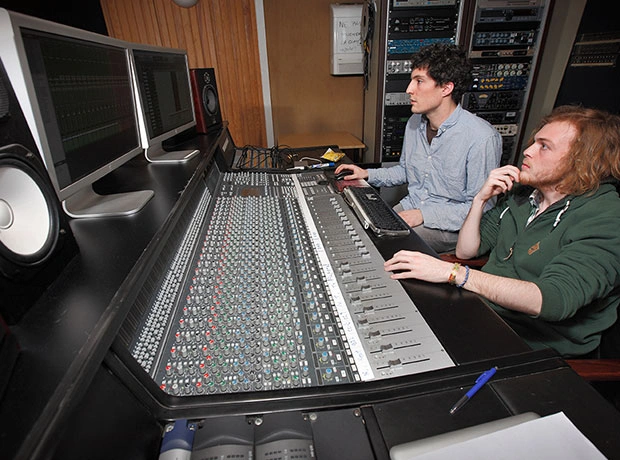
The artistic director, for his part, oversees the musical aspects of the recording on behalf of the producer. He is also distinct fromthe sound engineer, who sets up the microphones and operates themixing console: one decides what we want to hear, while the other ensures that we hear it. Sometimes, both roles are filled by the same person.
Who does the artistic director work with?
First, he works with the artist—whose creative vision he must understand—and then with the label’s artistic director, who oversees the project on behalf of the producer. In the studio, he directs the musicians, the backup singers, and the sound engineer.
After recording comes mixing and mastering. He also communicates with the publisher and co-authors when he is involved in composing or arranging the tracks.
What skills do you need to become an artistic director?
This profession requires a solid musical foundation and a trained ear: harmony, arrangement, rhythm, and knowledge of current styles and sounds. It also requires proficiency with production tools, such as digital audio workstations like Pro Tools, Logic Pro, or Ableton Live, as well as virtual instruments and sound processing.
The human element is essential: building trust with an artist, getting the right performance, and deciding between different opinions. Finally, you need to know how to stay within a budget and meet a studio schedule.
How much does an art director earn?
Artistic directors most often work as freelancers, and their compensation is negotiated on a per-project basis. It generally consists of a fixed fee for the production and, depending on the contract, a percentage of the album’s sales. When they also serve as composers or arrangers for the tracks, they receive additional royalties.
There is therefore no legally enforceable benchmark salary for this occupation. The only reliable publicly available figures pertain to the market in which he works:
| A Benchmark for the French Market in 2025 | Amount | Source |
|---|---|---|
| Revenue from recorded music | 1,071 million euros, up 3.9% | SNEP, 2025 Review |
| Including streaming | 702 million euros, or 65.5% of the total | SNEP, 2025 Review |
| Of which physical sales | 205 million euros, including 113 million for vinyl | SNEP, 2025 Review |
According to the SNEP, artists produced in France will account for three-quarters of the volume of the Top 200 in 2025. The market is therefore driven by local production, which supports French studios and artistic directors.
What kind of education is required to become an artistic director?
No specific degree s are required: a career in this field is built on completed projects and reputation. However, training in sound and music allows you to learn studio techniques more quickly and meet your first artists.
At ESRA, the ESRA Sound program is a three-year course leading to a state-accredited “ degree ” (Bac+3) degree, with more than 700 hours of instruction per year. In the third year, the music specialization covers composition, studio recording, mixing, mastering, and the production of original musical works. Students help run the school’s record label, 24 Tracks Records, whose artists performed at the New Morning during the 2023ESRA Sound Night, and in 2020, the label launched a mixing contest with radio students. The program is offered in Paris, on the French Riviera, in Brittany, and in Brussels.
What career opportunities and prospects are there?
Artistic directors work for record labels, independent artists, studios, the advertising industry, and the audiovisual sector. Many start out as studio assistants, sound engineers, or musicians before directing their first projects.
Among ESRA alumni, Maxime Morin (ESRA 2009) recorded a track for the album *H.E.R.*, which won the 2019 Grammy Award for Best R&B Album, and Antoine Chabert (ESRA 1994) mastered *Random Access Memories* by Daft Punk, which won three Grammy Awards in 2014. Career paths include becoming an artistic director at a record label, founding a studio or record label, or composing music for visual media.
Sources: Légifrance, Intellectual Property Code, Article L213-1; SNEP, 2025 Report on the Recorded Music Market, published on March 18, 2026. Verified on September 24, 2026.
Frequently Asked Questions
What is the difference between a "producer" and a "producteur"?
In French, the producer of a record is the label or artist who finances the recording and holds the rights to it (Article L213-1 of the Intellectual Property Code). The producer, in the English sense, is the artistic director who oversees the musical production.
How much does an art director earn?
There is no standard salary: they usually work as freelancers and negotiate each project, typically for a fixed fee and sometimes a percentage of album sales. If they compose or arrange the tracks, they also receive royalties.
Do you need a " degree " to become an artistic director?
No. A career in this field is built on completed projects. Training in sound and music helps you master studio work and meet your first artists.
What software does an art director use?
The most widely used digital audio workstations are Pro Tools, Logic Pro, and Ableton Live, supplemented by virtual instruments and audio processing tools.
What is the difference between an artistic director and a sound engineer?
The artistic director decides what we want to hear: interpretation, arrangement, and overall sound. The sound engineer handles the technical aspects: microphones, mixing console, and recording. Sometimes the same person fills both roles.
Does the artistic director compose the music?
Not always. In pop music, he often works on songs that have already been written. In urban and electronic music, the producer often composes the instrumentals himself.
The other cinema jobs

Audiovisual


Live


Programs offered at ESRA Paris
The school offers post-baccalaureate Programs in all three audiovisual fields. These Programs award a state-approved degree recognized by the French Ministry of Higher Education and Research.
Producer, Director, Editor
Audiovisual, Sound Systems, Music,
Radio, Video Games
Animation, 3D Compositing & VFX, Management & Production, Modeling
Master's-level Programs also on offer
Develop your technical and creative skills in the film industry with the Master DHEC, a state-approved degree .
To become a film producer, distributor, programmer, seller or buyer
Audiovisual, Live, Music,
Radio, Sound Design
DHEC Filmmaking
in English
To manage the entire production of a project: script writing, locations, casting...