The storyboard artist transforms a screenplay into a series of drawings, shot by shot. Each panel shows the frame, the characters’ positions, the camera movement, and the action, so that the entire team sees the film in the same way before it is produced. This profession plays a central role in animation and is also used in film, advertising, and music videos.
In a nutshell
- He breaks down the screenplay into storyboards, including the framing, the action, and the camera movements.
- His storyboard serves as a production plan for the entire team working on an animated film.
- Under a standard fixed-term contract, the minimum salary for an experienced storyboard artist is €781.03 gross per 35-hour workweek.
- According to the CNC, 16 French-produced animated films were approved in 2025, a record number.
- This profession is primarily practiced in animation studios, as well as in film, advertising, and music videos.
What does a storyboard artist do?
He reads the script and discusses it with the director, who explains his intentions. He then proposes a storyboard: where to place the camera, what shot size to choose, and how to sequence the shots to tell the story of the scene and give it its rhythm. The drawings are simple and quick; above all, they must be easy to understand.
The storyboard goes through several versions based on feedback from the director. In animation, it is then edited together with the voiceovers and a temporary soundtrack to create the animatic—a preliminary filmed version of the film that allows the production team to check the runtime and pacing before production begins.
In film and advertising, storyboards are primarily used to plan complex scenes, such as stunts or special effects shots, and to estimate the cost of production.
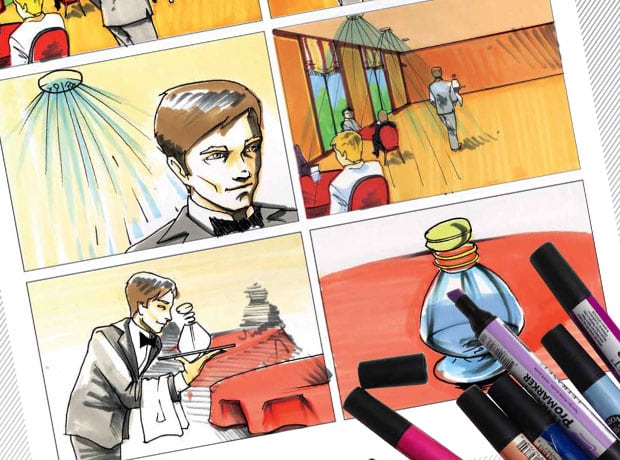
Storyboard, layout, or animatic: What's the difference?
A storyboard is a series of drawings that outline the film's sequence. An animatic is a storyboard edited together with sound to assess the pacing. Next comes the layout:the layout artist translates the storyboard into the film's 3D space, using a virtual camera and actual sets.
The collective bargaining agreement for the animation industry classifies storyboarding as part of the production team, with an assistant, a senior storyboard artist, and a chief storyboard artist.
Who does the storyboard artist work with?
He works closely with the director and, in the early stages, with the screenwriter, whose script he brings to life on screen. He collaborates with the art director and character designers to ensure the film’s visual style is maintained.
Down the line, his work serves as a reference for the layout teams, animators, and the editor, who creates the storyboard based on his drawings.
What skills do you need to become a storyboard artist?
You need to be able to draw quickly and clearly, using perspective, and convey an action with just a few strokes. Above all, you need to master the language of cinema: shot values, axes, continuity shots, camera movements, and editing rhythm.
You also need to know how to work on a tablet, using software like Storyboard Pro, and be willing to redraw a sequence several times. A storyboard artist is a director who draws.
How much does a storyboard artist earn?
In the animation film industry, the minimum salary for an experienced storyboard artist is €781.03 gross per 35-hour workweek under a standard fixed-term contract, or €3,384.53 per month. Under a permanent contract or a fixed-term contract governed by general labor law, the salary is €2,884.73 per month.
| Post-production, animated film production | Standard fixed-term contract, 35-hour workweek | Standard fixed-term contract, months | Permanent or fixed-term contract under general law, months |
|---|---|---|---|
| Assistant Storyboard Artist | 474,40 € | 2 055,65 € | €1,851.71, adjusted to the minimum wage: €1,867.02 |
| Experienced storyboard artist | 781,03 € | 3 384,53 € | 2 884,73 € |
| Lead Storyboard Artist | 866,23 € | 3 753,59 € | 3 186,72 € |
These amounts are taken fromAmendment No. 19 of June 14, 2024, to the collective bargaining agreement for animated film production (IDCC 2412), extended by decree on November 20, 2024; this is the industry’s most recent pay scale published on Légifrance. The minimum wage for an assistant on a permanent contract is lower than the minimum wage (SMIC), which has been €1,867.02 gross per month since June 1, 2026: therefore, the minimum wage (SMIC) applies.
According tothe CNC’s Film Production Observatory, 16 French-produced animated films were approved in 2025, a record number.
What kind of education do you need to become a storyboard artist?
This profession requires training in animation, illustration, or film, which teaches both drawing and directing. France Travail lists storyboard creation among the skills required for a 2D/3D animator. A portfolio of artwork is essential for landing your first job.
At ESRA, the ESRA Animation program is a three-year course leading to a state-accredited “ degree ” degree at the Bac+3 level, with more than 700 hours of instruction per year in 2D and 3D animation: art direction, character design (including rigging, textures, and lighting), storyboarding and layout, and the production of an animated film. In September 2026, the Network of French Animation Film Schools (RECA) awarded its accreditation toESRA Rennes, followed byESRA Paris.
What career opportunities and prospects are there?
Storyboard artists work for animation studios that produce films and TV series, film production companies, advertising agencies, and music video producers. The video game industry also employs storyboard artists for its cutscenes.
A career path leads to the position of lead storyboard artist and then to directing, since storyboarding already requires the kind of directorial decisions a director makes.
Sources: Légifrance, IDCC 2412 collective bargaining agreement, amendment No. 19 of June 14, 2024; CNC, 2025 Film Production Observatory; France Travail, ROME code L1510; minimum wage as of June 1, 2026. Verified on October 2, 2026.
Frequently Asked Questions
What does a storyboard artist do?
He turns the script into a series of drawings, shot by shot, that show the setting, the action, and the camera movements. This storyboard serves as a production guide for the entire team.
How much does a storyboard artist earn?
In animated film production, the minimum wage for an experienced storyboard artist is €781.03 gross per 35-hour workweek under a standard fixed-term contract, and €3,384.53 per month, according to the June 14, 2024, amendment to the collective bargaining agreement.
What is the difference between a storyboard and an animatic?
A storyboard is a series of drawings that outline the film's sequence. An animatic is a storyboard edited together with voiceovers and temporary music to check the runtime and pacing.
What software does a storyboard artist use?
He often draws on a tablet, using software such as Storyboard Pro. He still uses paper for his initial sketches.
Do you need to know how to draw to be a storyboard artist?
Yes, but the drawing must first and foremost be clear and quick. Mastery of the language of cinema—framing, continuity, and pacing—is just as important as the quality of the line work.
Can a storyboard artist become a director?
Yes, that's a possible development: the storyboard already calls for a director's staging choices.
The other cinema jobs

Animation


Programs offered at ESRA Paris
The school offers post-baccalaureate Programs in all three audiovisual fields. These Programs award a state-approved degree recognized by the French Ministry of Higher Education and Research.
Producer, Director, Editor
Audiovisual, Sound Systems, Music,
Radio, Video Games
Animation, 3D Compositing & VFX, Management & Production, Modeling
Master's-level Programs also on offer
Develop your technical and creative skills in the film industry with the Master DHEC, a state-approved degree .
To become a film producer, distributor, programmer, seller or buyer
Audiovisual, Live, Music,
Radio, Sound Design
DHEC Filmmaking
in English
To manage the entire production of a project: script writing, locations, casting...