The assistant director organizes the preparation and shooting of a film so that the director can focus on directing. He or she breaks down the script into tasks, creates a day-by-day shooting schedule, and manages the set to ensure that each scene is shot on time.
In a nutshell
- The first assistant director draws up the shooting schedule and runs the set, while the second assistant director prepares the call sheets and manages the extras.
- He serves as the liaison between the director, the production team, and the entire technical crew.
- On a movie set, the first assistant earns a minimum of €1,479.49 gross per week, based on a 39-hour workweek.
- According to France Travail, 92% of hires in production-related fields are for fixed-term contracts lasting less than one month.
- ROME Code: L1304, film and audiovisual production.
What does an assistant director do?
As part of the preparation, the first assistant breaks down the script: for each sequence, they list the sets, actors, props, vehicles, special effects, and extras. Based on this, they create the shooting schedule, which sets the order of filming while taking into account the availability of the actors, sets, and budget. They also organize technical location scouting and script readings.
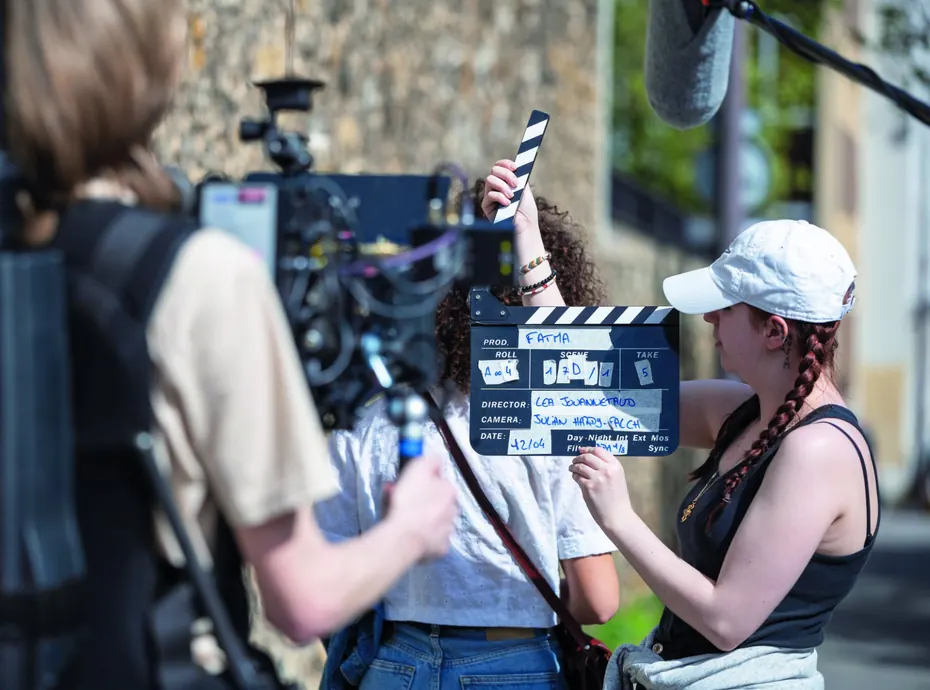
On set, he calls out each take, enforces silence, coordinates the actors’ and extras’ entrances and exits, and keeps an eye on the schedule. He plans ahead: while one shot is being filmed, he prepares the next one.
Every evening, the second assistant director prepares the next day’s call sheet, which includes everyone’s schedule, coordinates the actors’ arrival at makeup and costumes, and supervises the extras. On large productions, a third assistant and interns round out the team.
Assistant director or script supervisor: what's the difference?
The assistant director manages the schedule: he keeps the day moving and ensures that the entire shooting schedule is completed. The script supervisor ensures continuity: she records each take, the continuity of movements, costumes, and props, and the film’s timing.
Both work side by side with the director. The assistant director is not simply a second-in-command either: it is a distinct organizational role that many people pursue throughout their entire careers.
Who does the assistant director work with?
He is the director's right-hand man and knows the director's vision for each scene. He works closely with the production manager and the stage manager, who handle the budget, sets, and logistics.
On set, he coordinates all the department heads: camera, sound, lighting, stage mechanics, set design, costumes, and makeup. He also works with the casting director to coordinate the actors' schedules.
What skills do you need to become an assistant director?
It requires strong organizational skills, a good memory, and a real ability to plan ahead. The job requires knowledge of all the roles on a film set, so you know how long each setup takes.
Authority and a calm demeanor are also essential: the assistant director sets the pace for dozens of people, sometimes under time pressure, and must remain diplomatic with both actors and crew members. Proficiency in scheduling software and English—for international shoots—are valuable assets.
How much does an assistant director earn?
On a feature film, the minimum wage for the first assistant director is €1,479.49 gross per week, based on a 39-hour workweek. The minimum wage for the second assistant director is €1,070.37.
| Post Office, Movie Theater | Minimum gross weekly pay, based on a 39-hour workweek | Low-Budget Film (Appendix III) |
|---|---|---|
| First Assistant Director | 1 479,49 € | €1,082.91, plus €793.16 in revenue-sharing |
| Second Assistant Director | 1 070,37 € | €931.54, plus €277.67 in profit-sharing |
| Director, contract of less than five months, for comparison | 3 015,27 € | €1,651.15, plus €2,728.24 |
These amounts are taken from the wage scale in the collective bargaining agreement for film production (IDCC 3097), effective as of May 1, 2026. For low-budget films listed in Appendix III, the base wage is lower but is supplemented by a share of the film’s box office receipts. Television is governed by other collective bargaining agreements.
The work is done on a film-by-film basis. For all film production occupations (ROME code L1304), France Travail reported 70 job openings over a 12-month period for 3,690 job seekers in the first quarter of 2026, and 92% of the hires were for fixed-term contracts lasting less than one month.
What kind of education do you need to become an assistant director?
No specific degree is required, but attending film school allows you to learn about all the roles on a film set and gain hands-on experience in production on actual films. You typically start as a director’s intern, then move on to third or second assistant.
At ESRA, the ESRA Cinema program is a three-year course of study leading to a state-accredited “ degree ” degree (equivalent to a three-year post-secondary degree), with more than 700 hours of instruction per year and at least two productions per year, which are screened before a jury; career opportunities include working as an assistant director. In the third year, the production specialization focuses on organizing a film shoot, from management through to delivery.
What career opportunities and prospects are there?
Assistant directors work on feature films, TV series, TV movies, and commercials, both in France and on international film sets. Among ESRA alumni are three first assistants: Stéphane Gluck (ESRA 1986) worked on *Taxi* and *The Diving Bell and the Butterfly*, Carole Schmidlin (ESRA 2001) on the series *Emily in Paris* and *Lucy*, and Valérie Aragües (ESRA 1990) on *Un p’tit truc en plus* by Artus, the most-watched film in French theaters in 2024 according to the CNC.
Some spend their entire careers as first assistants; others move on to directing or production management. Carine Tardieu, who studied at ESRA, first worked as an assistant director or screenwriter before directing her own films.
Sources: Légifrance, IDCC 3097 collective bargaining agreement, pay scale as of May 1, 2026; France Travail, ROME code L1304; CNC, 2024 attendance report. Verified on September 24, 2026.
Frequently Asked Questions
What does an assistant director do?
He organizes the preparation and filming: he breaks down the script, creates the shooting schedule, directs the set, and keeps the day on track so that each scene is shot on time.
How much does an assistant director earn?
On a film set, the minimum gross weekly pay is €1,479.49 for the first assistant and €1,070.37 for the second assistant, based on a 39-hour workweek, according to the pay scale in effect as of May 1, 2026.
What is the difference between a first assistant director and a second assistant director?
The first assistant sets up the set and oversees the set. The second assistant prepares the call sheets, coordinates the actors' arrivals, and directs the extras.
What is a work plan?
This is the shooting schedule, drawn up by the first assistant director. It sets the order in which the scenes will be shot, based on the sets, the actors, and the budget.
Do you need a " degree " to become an assistant director?
No. However, film school does help you learn about all the different roles and gain hands-on experience on actual film sets. You often start out as an assistant director.
Can an assistant director become a director?
Yes, some do go on to become directors, but many spend their entire careers as first assistants—a profession in its own right. Carine Tardieu, who studied at ESRA, worked as an assistant director or screenwriter before directing her own films.
The other cinema jobs

Director of Photography


Production and Distribution

Film Directing,
Series and TV
Programs offered at ESRA Paris
The school offers post-baccalaureate Programs in all three audiovisual fields. These Programs award a state-approved degree recognized by the French Ministry of Higher Education and Research.
Producer, Director, Editor
Audiovisual, Sound Systems, Music,
Radio, Video Games
Animation, 3D Compositing & VFX, Management & Production, Modeling
Master's-level Programs also on offer
Develop your technical and creative skills in the film industry with the Master DHEC, a state-approved degree .
To become a film producer, distributor, programmer, seller or buyer
Audiovisual, Live, Music,
Radio, Sound Design
DHEC Filmmaking
in English
To manage the entire production of a project: script writing, locations, casting...